Check here for the NYT's large collection of articles by and about this great American writer
Saturday, November 10, 2007
Saturday, November 03, 2007
Words are pouring out like endless rain into a paper cup
The following was written not as a formal review but as a letter to a friend discussing Julie Taymor's Across the Universe. Rather than try to prod it into a more formal piece of criticism, I'm putting it up here as is...
"I don't know that I've seen anything this year that I've liked nearly as much as "Across the universe", but, as I mentioned earlier, I was originally skeptical. First of all, the trailer raised comparisons with Milos Forman's misguided 1979 version of "Hair", a movie that was either 10 years too late or 25 years too early. (There are a few similarities in the storylines - and it's not unrealistic to think that Taymor is probably familiar with a production or too)..
Secondly, when you think of some of the awful liberties that have been taken with the Beatles catalogue over the years, by literalists who think that they have to make a live-action version of "Yellow Submarine" (as in the Bee Gees "Sgt. pepper" and a very shortlived mid-70s Broadway disaster of the same name) or, even worse, reduce the songs to cliched background jingles for lots of kids in bad wigs and exaggerated fringe-y hippie clothes flashing peace signs and carrying on like a group of street mimes on laughing gas (see Milos Forman's "Hair"....)
I should add that there was also a 3rd thing that made be a little doubtful; I heard parts of the soundtrack and was put off by the working-class accents ("Close yer eyes and I'll kiss yer, tomorrow I'll miss yer"), the desperate, plaintive opening of "I Want to Hold Your Hand", the chamber-like arrangements - all things which turned out to work much more effectively in the film than I would ever have guessed.
With those serious doubts (slightly lessened by having watched "Frida" a few week ago . I still haven't seen "Titus", but it's been on my order list with the library for months...) I have to admit that I was won over by the film almost instantly, from the introduction of parallel narrative lines during "It Won't be long now". By the time of "All My Loving" and "I Want to Hold Your Hand" came around, it was clear that the film wasn't just a nostalgic trip through the Beatles repertoire and that the songs were going to be placed with the context of the characters, accents, plaintiveness and all.
Which is one of the first really original things about Taymor's approach. While the film is obviously very stunning visually, it's NOT just a string a music videos or, even more importantly, a series of isolated episodes designed to illustrate the songs (see again the Bee Gees movie, "All This And World War Two" etc...). . You have to buy into the characters' lives first - their accents, high school crushes, family issues, etc... . The songs - and this is especially tricky, given their familiarity and frequent ventures into surrealism - have to make the movies emotional points work too or else they'll stop the story dead still...
Which is not to say that the film isn't also about the Beatles or ignores the fact that just about every song in it has its own substantial legacy - artistically, culturally, historically. But one of the most brilliant things that Taymor does is to consider all of those factors as a kind of collective unconscious, a shared backstory that the audience has with the characters. I cringed at first when I realized that the characters all had names derived from Beatles' songs (Max, Lucy, Prudence, Sadie, etc..) thinking that this would be another example of the dead literal-mindedness of the BeeGees film (Of course, "Yellow Submarine" does a little of the same thing with puns, etc...but gets away with it ), but because Taymor understands or assumes our familiarity, she doesn't have to be so bone-crushingly obvious. In fact, she doesn't even actually have to include "Sexy Sadie" or "Maxwell's Silver Hammer" or "She Came In through the Bathroom Window" for the audience to register those songs.
Let me digress for a minute: Several years ago there was an absolutely awful movie based on "The Mod Squad", arguably one of the worst movies of the last 10 or 15 years. At the end of the film, when the heroes are sitting around without much to do, one of the cops walks up to them and says "What do you guys think you are, some kind of "Mod Squad"?" It's a weird cultural reference point, because the cop and the audience know what the characters themselves don't; In a sense, they're the only people in the universe that have never heard of "The Mod Squad".
You might think that "Across the Universe" might have that same kind of problem. how do you put your characters into some kind of archetypal "1960s" world in which they've never heard of the Beatles or those songs? But you don't get that sense of absence in the film. Rather, it's a kind of alternate 1960s in which the recognizable songs become a kind of ethereal vapor running through their lives and through the universe itself. It doesn't matter that we have "Let It Be" being song in 1964 or 65, 5 years before it was written. The film operates in a realm where memory reconstructs history.
Which brings me to a final clever thing that the film does really well. Yes, it's about the "1960s" with all the pertaining cultural baggage that entails. But it references the key points of the period - civil rights, Vietnam, the Columbia uprising, the Weathermen,etc. - in a very clever way that avoids banality and nostalgia or the kind of superficiality that many accuse "Forest Gump" of using in its approach to history. Taymor does a very shrewd thing in relying on the viewers interest/boredom/awareness/ in that era by making it alive yet almost secondary to the characters and their lives. Thus, we have these familiar events but played on a different scale. A Hendrix figure who is obviously not Hendrix, referencing the idea of Hendrix without resorting to a banal roman-a-clef approach. The Bono figure, who is Tim Leary and Ken Kesey and yet not really either of them. The famous "Let It Be" rooftop concert, used in a completely new context, yet not really having to carry any of the historical weight of the actual event... (No band breaking apart, no Yoko), This too is a refreshing approach to the history, a sense not of name-checking the events and names of the period but of trying to address the emotional issue of what it was like to live through such things.
Funny that you should mention favoring the "Come Together" and "I Want You" sequences, arguably the most surreal in the film. I think my reaction was a little different. And despite the appearances of Joe Cocker, Eddie Izzard and Bono, I don't think the film gives the sense of dropping-in-famous-guest-stars-to-keep-the-audience-busy (a la "Tommy" or "Sgt. Pepper"). I think I was more drawn in by the principals and their stories, the way their lives were never shoved aside by the spectacle or the music. That's why in the middle of all of the more fantastic elements it's still a nice surprise when Prudence reappears, Sadie resolves her problems or Lucy turns up across the rooftop at the end. The movie gets to the heart of how music (and especially this music) and emotion and intense cultural events change the way people think and behave.
Yes, I'm rambling on pretentiously, but this film grabbed me straight in the heart in a big way, not just once but probably with about every other song. I react emotionally to musicals (and children's movies) but this was more than the usual response, which can probably be defined as how-can-anything-be-so-perfect? (as Gene Kelly and Debbie Reynolds getting together or Pinocchio coming back to life)? There's that too, of course, but I think that what "Across the Universe" touches is that magical and elusive sense of possibility that is so well defined by the Beatles' music and their cultural significance. yes, it's easy to dismiss "All You Need Is Love" as a corny statement, but when you hear those odd harmonies and irregular time signatures and daft counterpoints, it's just as easy to wish that it was some sort of organized movement because , damned if you're not ready to sign up. "Nothing's gonna change my world"? Hardly.
Okay. I'm all pontificated out."
Saturday, September 29, 2007
Sunday, September 23, 2007
Crazy world
If it's true, this may be the singularly most unusual "old Hollywood" story I've ever heard. But I'll just direct you to the source. For the last few weeks, a gossip blogger who uses the name "Ent Lawyer" (is that some kind of Tolkien thing?) has been drawing attention with his story that an award-winning actress was actually a man. Here's the original blind item as it appeared on his blog "Crazy Days, Crazy Nights" three weeks ago, and here's the wrap-up where he tells the whole story.
I suppose you know this means war...
The first of these has been around for over a year, and the sequel's been up since March, but I just ran across them. Some of the best Flash animation I've seen, and a sort of contemporary "Duck Amuck". The artist's name is Alan Becker (according to his web page, he's only 18) and you can find more of his work here.
Animator vs. Animation by *alanbecker on deviantART
and the sequel:
Animator vs. Animation II by *alanbecker on deviantART
Animator vs. Animation by *alanbecker on deviantART
and the sequel:
Animator vs. Animation II by *alanbecker on deviantART
Saturday, August 11, 2007
Bonnie and Clyde and Ingmar and Harry
It wouldn't be much of a weekend without an arts overload from the New York Times, would it?
A.O. Scott looks at the 40th anniversary of Bonnie and Clyde and feels guilty...
Woody Allen recalls Ingmar Bergman,
Martin Scorsese weighs in on Michelangelo Antonioni,
and Christopher Hitchens holds forth on the latest and last Harry Potter book.
A.O. Scott looks at the 40th anniversary of Bonnie and Clyde and feels guilty...
Woody Allen recalls Ingmar Bergman,
Martin Scorsese weighs in on Michelangelo Antonioni,
and Christopher Hitchens holds forth on the latest and last Harry Potter book.
Friday, August 03, 2007
Tuesday, July 31, 2007
Michelangelo Antonioni, 1912 - 2007
..And just on the heels of yesterday's news comes another obituary. It's the end of an era for the giants who reshaped international cinema in the postwar years.
Details and appreciation here, plus a guide to scenes from his films on YouTube.
Monday, July 30, 2007
Ingmar Bergman, 1918-2007
One of the true giants of international cinema has passed away. There's much to read and remember from the New York Times and the Guardian.
Wednesday, July 25, 2007
...having a cow
Ignore the usual sour-grapes that are bound to follow anything that has been around as long as it has. The Simpsons isn't just a long running tv series; it's mankind's greatest achievement! Says so right in The Onion's A.V. World, where they're commemorating the release of The Simpsons Movie with an entire week of Springfield-related content. For starters, try this list of "15 Simpsons Moments that Perfectly Captured their Eras" . I couldn't agree more with No. 6, which sums up the post-ironic age perfectly when Homer goes on the road with Lollapalooza (his act consists of being hit in the stomach by a cannonball), prompting this audience exchange:
"Oh, here comes that cannonball guy. He's cool."
"Are you being sarcastic, dude?"
(after a desparate pause...)
"I don't even know any more."
Below, one of the great Simpsons guest star appearances:
"Oh, here comes that cannonball guy. He's cool."
"Are you being sarcastic, dude?"
(after a desparate pause...)
"I don't even know any more."
Below, one of the great Simpsons guest star appearances:
Monday, July 23, 2007
First things
"First things are always beautiful", as the critic and novelist Gilbert Adair accurately said of this film. More than eleven decades have passed since the Lumiere brothers first presented this work to the public, but it's lost none of its magic. Look! it says. Here is the real world of people and animals and bicycles and traffic. It's alive, it's real and above all, it moves!
Sunday, July 22, 2007
New Royalty: the Purple Edition
The Artist Still Known as Prince has been very busy lately, launching a new fragrance (scratch here for a sample), opening a club in Las Vegas,playing lengthy sold-out engagements in Los Angeles and London (What? He's only playing in cities that start with "L"?), preparing for a religious sabbatical sometime next year, and - this week - releasing a pretty darn good new album, "Planet Earth", which marks the return of former Revolution-mates Wendy and Lisa. In the New York Times, Jon Pareles explains that Prince could pretty much rule the world if he wanted to, while Time and the Guardian explain why he's giving the record industry fits. Though it seems to me that the clip below might be a pretty good reminder as well.
Saturday, July 21, 2007
A lot of nerve
Besides his own excellent work as a solo artist and with Roxy Music, Bryan Ferry has always been one of the most gifted interpreters of other songwriters' work, his smooth and subdued lounge-lizard vocals bringing an air of world-weary melancholy to everything from The Velvet Underground to "You Are My Sunshine". From the blistering version of "A Hard Rain's A Gonna Fall" that opened his first solo album, 1973's "These Foolish Things" to the pairing of "It's All Over Now Baby Blue" and "Don't Think Twice It's All Right" on 2002's "Frantic", Ferry has revealed a surprising affinity for the work of Bob Dylan, culminating in what seems in retrospect like an inevitable event, his latest album "Dylanesque". Browsing through the Dylan catalog, Ferry explores everything from light-hearted pop to Hendrix-inspired noise to make even such familiar and inimitable songs as "Simple Twist of Fate" and "Just Like Tom Thumb's Blues" into a personal cabaret. The highlight is this poignant, haunting resetting of one of Dylan's most bitingly angry songs, "Positively 4th Street".
Friday, July 20, 2007
...radio on
It's punk-nostalgia time for the Guardian's Film and Music Weekly. The highlights: Alex Cox offers a punk-movie manifesto and Laura Barton traces the route of one of the greatest pop songs ever. Also feature: the original rude boy, Derek Jarman's Jubilee and Christmas with the Sex Pistols.
Monday, July 16, 2007
Just like a woman...
Finally, some footage from one of the most anticipated films of the year, I'm Not There, in which director Todd Haynes (Velvet Goldmine, Far From Heaven) sets his sights on Bob Dylan, with The Man From Hibbing played by six different actors of varying race and gender, Heath Ledger and Richard Gere among them. The clip below features Cate Blanchett as the Don't Look Back-era Dylan, with David Cross as Allen Ginsberg.
(A big thanks to Hollywood Elsewhere and The L.A. Times' Gold Derby for the link, though I have to take exception to the latter's complaint that Blanchett isn't "believable". Whatever Haynes' is up to here, it should be pretty obvious that it's not realism.)
Sunday, July 15, 2007
Have you seen me?
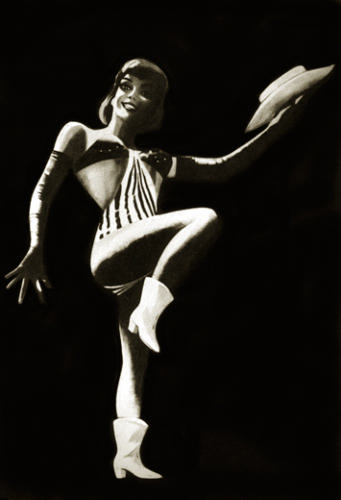
You may recognize the lovely lady to the right from the cover of Gore Vidal's classic "Myra Breckenridge", but before securing that modeling gig she was a fixture of the Sunset Strip, perched on a giant coin as part of a billboard advertising the Sahara Casino and located in front of the legendary/notorious Chateau Marmont.
But an even odder appropriation of the cowgirl statue has been brought to my attention, courtesy of Domenic Priore's "Riot on Sunset Strip" (reviewed below).
Speaking of Hollywood landmarks, a friend directed my attention to Hollywood Lost and Found, a modest but entertaining selection of Southern California history, movie lore and other miscellany, including this rather disturbing image (Warning!: Contains Clowns!)
Is it really possible that both of these satirical classics are out of print?
Finally, here's an apocalyptic theme song for the day:
Saturday, July 14, 2007
"To smoke and have coffee...and if you do it together, it's fantastic!"
The almost indescribable Wings of Desire ("Der Himmel uber Berlin") is 20 years old this month. On his website, director Wim Wenders is justifiably proud of his much-loved creation. If you haven't seen it (or if you've had the misfortune of seeing the American remake), ..what are you waiting for?
Friday, July 13, 2007
Heard you missed him, now he's back...
I was fortunate enough to see Sly and the Family Stone perform live in 1973, right on the heels of their last great album Fresh and they were amazing. Sly's rapid decline and gradual withdrawal from the music world has made him the last of the legendary recluses in music but, as this interview in the current Vanity Fair reveals, the musician's long absence from the public eye may be coming to an end. Hot fun in any season.
Bookmobile
Thanks to an item at Trio for introducing me to Literary Traveler (even though it's been around since 1998!), a website about books and authors and the places they lived and wrote about. Each month is devoted to a particular theme, currently "Western Literature" (as in cowboys and covered wagons). Recent subjects have included children's books and pirates, and the individual articles on the site run the gamut from the Victorian England of Beatrix Potter to the Puerto Rico of Hunter S. Thompson's "Rum Diary".
Thursday, July 12, 2007
There's a Riot Going On
The Riot on Sunset Strip (the historical event) was a spontaneous protest that erupted one night in November 1966 when Los Angeles police, prompted by local business interests, tried to enforce a curfew law in order to drive out the teenaged crowds who had dominated the area’s club scene for the previous few years.
Riot on Sunset Strip (the movie) was a quickly-produced exploitation film with production values slightly lower than an episode of “Dragnet” but with performances by some of the authentic Sunset Strip bands of the period (The Standells and The Chocolate Watchband among them). Cult starlet Mimsy Farmer falls in with a bad crowd, to the dismay of her estranged father, policeman Aldo Ray.
“Riot on Sunset Strip: Rock ‘n’ Roll’s Last Stand in Hollywood” (Jawbone Press, 288 pp., $29.95) is probably the definitive look at the period that lead up to the above two items, but for author Domenic Priore the real riot of the period was a cultural breakthrough that produced an onslaught of significant music in those strange few years before AM top 40 gave way to unprogrammed FM.
Priore's premise is that after the immediate shock of the British invasion Los Angeles responded in kind by becoming the musical and cultural capital of all things young and new. Besides obvious heavyweight acts like The Byrds, Frank Zappa, Love and the Doors, it was an environment in which all kinds of music from surf to psychedelia, from the feel-good pop sounds of the Turtles and The Mamas and the Papas to proto-punk garage bands like The Seeds and The Knickerbockers flourished and encouraged each other.
Priore is a pop culture historian and enthusiast with an encyclopedic grasp of the period as well as, I'd guess, an extensive record collection and a complete run of "Hit Parader" back issues. He can tell you not only how many different bands recorded "Hey Joe" but how many recorded "She Sang Hymns Out of Tune". Hardly an aspect of pop culture of the era, from art to appearances on. Hanna Barbera cartoons escapes his attention. The result is an exhaustive, handsomely designed volume that not only recreates the spirit of that brief period in L.A. history but will have you scribbling lists of obscure tracks and forgotten bands worth tracking down. His grasp of the period is strong enough to defend even the most commercial projects of the time (Hey, Hey, they're the Monkees) and as well as to define the Sunset Strip period within history and distinguish it from the later excesses of the San Francisco sound and the rise of FM-radio Album-oriented rock. His is a lively, informative and always entertaining history of a microcosmic teenage culture that burned brightly and disappeared too fast.
Subscribe to:
Posts (Atom)