It's the 40th anniversary of the Summer of Love. You know what they say: If you can remember it, you weren't there. And if you weren't there, you can read this lengthy look back courtesy of Peter Weir, Country Joe McDonald, Bob Weir and others, as recorded by Ed Vuliamy for the Guardian.
And more on the institutionalization of 1967, via the New York Times.
Saturday, May 19, 2007


Friday, May 18, 2007
It's only fair.

Looking for an explanation of copyright that gets to the point while simultaneously forcing the whole "fair use" issue by deliberately exploiting the work of its biggest opponent? In this mash-up from the Media Education Foundation at Stanford, Woody, Buzz, Jasmine, Ariel and all their friends break away from their attorneys just long enough to explain it to you.
Sunday, February 25, 2007
Then and Now. And Later.
Using "Babel" as a starting point, David Denby has some interesting thoughts on the current popularity of non-sequential narrative in "The New Yorker". (Read it quick; it won't stay on line forever.)
By the way, I share his suspicion of "Babel", a film which pretends to a kind of humanism while depicting almost all human behavior (except that of his primary protagonists) as brutal, uncaring and suspicious.
By the way, I share his suspicion of "Babel", a film which pretends to a kind of humanism while depicting almost all human behavior (except that of his primary protagonists) as brutal, uncaring and suspicious.
Monday, February 19, 2007
Ryan Larkin

Green Cine Daily, Movie City News and several other places have already reported this, so I'm just passing it along. Ryan Larkin, the Canadian animator whose award winning "Walking" was an art-house staple in the 70s, and who was himself the subject of the brilliant and disturbing film "Ryan", has died of lung cancer. Those who have seen "Ryan" will be relieved to know that Larkin had managed to pull his life a little closer to normalcy in the last few years and had recently produced short "bumper" films for the Canadian version of MTV.
The obituary from "The Toronto Star" is Here.
You can watch "Walking" on the National Film Board of Canada site, read more and view clips at "Cartoon Brew" and see an excerpt from "Ryan" at Movie City News.
Sunday, February 18, 2007
All Yesterday's Parties
I've been trying for weeks to write something about George Hickenlooper's Factory Girl, but there's really nothing much to say about this lazy biography of Edie Sedgwick, which plays like a superficial, generations-removed-from-the-facts account of a life which leaned too heavily on the side of superficiality to begin with. You probably know the outline of the story, its cult like status due largely to the popularity of Jean Stein and George Plimpton's exhaustive 1982 oral history "Edie: An American Biography": Poor Little Rich Girlfalls in with the Andy Warhol crowd, becomes the Flavor of the Week but quickly makes a sharp descent into drugs and mental illness. It's a tragedy of sorts, but there's not enough in "Factory Girl" to overcome the film's gossip-driven "People Magazine" view of history.
Yes, there are entertaining moments. Sienna Miller provides many of them, even though the script often makes her sound like a bubble-headed freshman art student. Guy Pearce also has a few good scenes as enigmatic Warhol, but just as many in which the film simply has him mimic some of the artist's familiar tv appearances. Warhol utters some naive quip, Edie gushes about what great work he's doing and the filmmakers hope that creating a resemblance to an old photograph of the Factory crowd will pass for substance.
For a few scenes, it almost works (though the depiction of Warhol's film work is completely off-track)but the credibility factor is strained. That strain becomes completely and irrevocably unsalvageable with the appearance of Hayden Christensen as a character labeled only "Musician". (Earlier versions of the credits called him "Billy Quinn". Perhaps the change was intended to make him more mysterious, but I prefer to think that all of the world's real-life Billy Quinns raised an objection..) It doesn't take much more than a look at his album-cover inspired wardrobe to realize that he's a thinly disguised Bob Dylan, but Christensen seems to have gotten his Midwestern rebel icons all mixed up and falls into an confusing imitation of James Dean. To the degree that "Factory Girl" has a coherent storyline, it seems to be that "Musician" is the serpent to Edie's Eve, placing doubts in her mind about Warhol and causing the artist to banish her from his silver-lined Eden. (This may be a slight exaggeration of whatever real relationship existed between Sedgwick and Dylan; at any rate, it merits only two-and-a-half pages in the Stein and Plimpton book.) Once the bubble of the Warhol Sixties has popped, neither the film nor its version of Edie has anywhere to go but down.
The real Edie's decline was no less rapid, but it's been well-documented, not just in the Stein/Plimpton book but in "Ciao! Manhattan", a stoned mess of a film that she was working on in her final days. Completed after her death and released almost a decade later to benefit from the book's popularity, it's an unpleasantly exploitative film, but so blatant in its use of the brain-fried actress that it reveals as much about her sad end as you would probably ever want to know. It would be interesting to see it placed side by side with one of her Warhol performances, like "Poor Little Rich Girl", a lengthy close-up of the young woman rambling on about very little on a typical day at the height of her Factory career (It actually adds to the effect of the film that more than half of it was shot out of focus..). Exposed for the camera, these two films might serve as bookends to her short and unfortunate life, the Edie in her prime no less (or more) shallow than the stumbling, topless train-wreck of the final work.
Yes, there are entertaining moments. Sienna Miller provides many of them, even though the script often makes her sound like a bubble-headed freshman art student. Guy Pearce also has a few good scenes as enigmatic Warhol, but just as many in which the film simply has him mimic some of the artist's familiar tv appearances. Warhol utters some naive quip, Edie gushes about what great work he's doing and the filmmakers hope that creating a resemblance to an old photograph of the Factory crowd will pass for substance.
For a few scenes, it almost works (though the depiction of Warhol's film work is completely off-track)but the credibility factor is strained. That strain becomes completely and irrevocably unsalvageable with the appearance of Hayden Christensen as a character labeled only "Musician". (Earlier versions of the credits called him "Billy Quinn". Perhaps the change was intended to make him more mysterious, but I prefer to think that all of the world's real-life Billy Quinns raised an objection..) It doesn't take much more than a look at his album-cover inspired wardrobe to realize that he's a thinly disguised Bob Dylan, but Christensen seems to have gotten his Midwestern rebel icons all mixed up and falls into an confusing imitation of James Dean. To the degree that "Factory Girl" has a coherent storyline, it seems to be that "Musician" is the serpent to Edie's Eve, placing doubts in her mind about Warhol and causing the artist to banish her from his silver-lined Eden. (This may be a slight exaggeration of whatever real relationship existed between Sedgwick and Dylan; at any rate, it merits only two-and-a-half pages in the Stein and Plimpton book.) Once the bubble of the Warhol Sixties has popped, neither the film nor its version of Edie has anywhere to go but down.
The real Edie's decline was no less rapid, but it's been well-documented, not just in the Stein/Plimpton book but in "Ciao! Manhattan", a stoned mess of a film that she was working on in her final days. Completed after her death and released almost a decade later to benefit from the book's popularity, it's an unpleasantly exploitative film, but so blatant in its use of the brain-fried actress that it reveals as much about her sad end as you would probably ever want to know. It would be interesting to see it placed side by side with one of her Warhol performances, like "Poor Little Rich Girl", a lengthy close-up of the young woman rambling on about very little on a typical day at the height of her Factory career (It actually adds to the effect of the film that more than half of it was shot out of focus..). Exposed for the camera, these two films might serve as bookends to her short and unfortunate life, the Edie in her prime no less (or more) shallow than the stumbling, topless train-wreck of the final work.
Tuesday, January 02, 2007
Vice. Versa
Performance - which will be getting its long overdue DVD release shortly - is also the subject of this exhibit..
Tuesday, November 21, 2006

Sunday, November 19, 2006
One for now, one for later

It's hard to describe Guilermo del Toro's Pan's Labyrinth: It's a fairy tale for adults, a fantasy film about real-life monsters. It's a haunting film, and the more I think about it, the more I like it. I'll say more about it later, but for now think of Borges writing for the Muppets, with Bertolucci directing. Can't imagine that? Good, because that doesn't quite do it justice anyway. The Guardian offers a peek at some of the director's sketches and notebooks for this dreamlike film here.
And while it will probably be another year before we get to see it, a new film by Wong Kar-Wai is always a dreamy experience. His next, My Blueberry Nights, is an American road movie starring Jude Law, Natalie Portman and Norah Jones. The New York Times takes an advance look at the map.
Until then, here's two small tastes of WKW, the DJ Shadow music video "Six Days" and a very short commercial for Lacoste.
Sunday, November 12, 2006
Critical Voices
He can be infuriating, dogmatic, even a bit irrational, but there's little doubt that Robin Wood is one of the most important voices in film criticism, as much now as he was forty years ago. His books on Hitchcock and Hawks are essential contributions to auteurist thinking, his work on horror films (focusing on DePalma, Cronenberg and Cohen) set standards for ideology and genre-based criticism that have yet to be matched, and above all, his relentless honesty about his own life and his willingness to modify his positions over time are a model to anyone who expects criticism to be more than a breathless exclamatory quote for the benefit of film publicists. This brief but fascinating interview from "Your Flesh" offers a kind of "Beginner's Guide" to some of Wood's interests over the years. But don't stop there: If you haven't already read them, proceed immediately to the books below.
Friday, November 10, 2006
"A need for truth"
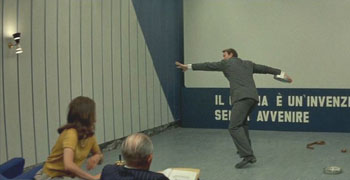
Moviegoers in New York (and later, Los Angeles and London) can take in a retrospective of the work of a cinematic master, Roberto Rossellini. The rest of us will just have to make do with the few available titles on video and this assessment by Manohla Dargis in the New York Times.
In Memoriam: Most of the obituaries of Fereydoun Hoveyda, who died a few days ago, make note only of his role as an Iranian diplomat, but film enthusiasts may remember him just as well as one of the founders of "Cahiers du Cinema" and one of its most enthusiastic contributors in the 1950s. This article from The Persian Mirror takes a closer look Hoveyda's critical skills and interest in the arts, and provides a link to this brief note on the roots of his cinephilia.
In Memoriam: Most of the obituaries of Fereydoun Hoveyda, who died a few days ago, make note only of his role as an Iranian diplomat, but film enthusiasts may remember him just as well as one of the founders of "Cahiers du Cinema" and one of its most enthusiastic contributors in the 1950s. This article from The Persian Mirror takes a closer look Hoveyda's critical skills and interest in the arts, and provides a link to this brief note on the roots of his cinephilia.
Sunday, November 05, 2006
It's only rock and roll...

...but the news that Martin Scorsese is working on a documentary/concert film about the Rolling Stones - and with documentary giant Albert Maysles (Gimme Shelter), no less - is pretty exciting. Scorsese's No Direction Home was pretty close to a masterpiece, but deliberately limited in its scope, focusing entirely on the first half of the 1960s and using the Dylan's conversion to electric music and the release of "Like a Rolling Stone" as a climax. I suspect that his affinity for the Stones and his gift for capturing live performances will push the new film in other directions. At any rate, this comes close to tying Todd Hayne's I'm Not There as the most interesting musical project of 2007.
Other musical diversions:
Is there really a statue of Willie Nelson in Nacogdoches TX, or is this just something they worked up for an album cover?
If it's for real, I want a whole carton of postcards.
And finally, two websites that have wasted a trickload of my time recently:
- Bedazzled! - it's like YouTube for people with eccentric tastes in old pop music.
- the official site for the Tenacious D movie - worth exploring at length, especially the "Satan's VCR" and "Rock The Internet" sections (though the latter was a bit slooooooowwwwww).
Saturday, November 04, 2006
Charlie Chaplin to D.W. Griffith: "I don't know about you, but I'm starting to get dizzy"

From a much-reprinted press release earlier this week:
"Tom and Paula are the modern versions of the iconic founders of United Artists - Douglas Fairbanks, Mary Pickford, Charlie Chaplin and D. W. Griffith - and our partnership with them reaffirms our commitment to providing creative talent with a comfortable home at United Artists and a dedicated distribution partner in MGM. United Artists is once again the haven for independent filmmakers and a vital resource in developing quality filmed entertainment consistent with MGM's modern studio model."
All of which suggests a grest new game: What contemporary celebrities can be lauded as inappropriate equivalents to silent stars?
Jennifer Aniston is the modern Clara Bow.
Paris Hilton is the modern Greta Garbo.
Madonna is the modern Nazimova.
The Wayans Brothers are the modern Laurel and Hardy.
Any contributions defining the modern Buster Keaton, William S. Hart, Louise Brooks, Gloria Swanson or Fatty Arbuckle are welcome.
Wednesday, November 01, 2006
Exercise your right to vote...
Sunday, October 22, 2006
What so proudly we hail...
Clint Eastwood’s devastating Flags of Our Fathers isn’t really a war movie. Or more precisely, it’s much more than a war movie. It’s a meditation on war, on the gap between the nightmarish events experienced by those who fight and the superficial imagery that those outside of war manipulate in the name of politics and patriotism.
It’s the story of an image, the famous photo of American soldiers raising the flag at Iwo Jima: You’ve seen the picture a thousand times but the ideas behind it – the heroism that you might have taken for granted, just as awestruck observers did when it turned up on every front page back in 1944 - are far more complicated. Used as a symbol of the final rush to victory at the end of World War Two, it’s a powerful icon. But as this film shows, it remains just a symbol, and the gap between that familiar but faceless group struggling with a flagpole and the real lives of the six men in the photo is bitter and heartbreaking.
That Eastwood is a masterful director is no surprise to anyone who’s followed his career, but as he gracefully allowed his own career as an actor to take a backseat, he is becoming increasingly ambitious, backing away from conventional narratives and allowing his films to breathe with their own sense of rhythm and environment. Just as Million Dollar Baby started out as a sports movie and trapped the audience into experiencing something far more deep and disturbing, Flags of Our Fathers starts with a few familiar notes from war movies and nostalgia, but they’re just part of a subtle plan to strip the glamour from the victory rallies and photo opportunities and reveal the real aftermath of war on the men who fought it. Just as his last film considered life and death with insight and depth but without a trace of sentimentality, Eastwood raises issues about war and heroism that few other filmmakers dare to approach.
It’s the story of an image, the famous photo of American soldiers raising the flag at Iwo Jima: You’ve seen the picture a thousand times but the ideas behind it – the heroism that you might have taken for granted, just as awestruck observers did when it turned up on every front page back in 1944 - are far more complicated. Used as a symbol of the final rush to victory at the end of World War Two, it’s a powerful icon. But as this film shows, it remains just a symbol, and the gap between that familiar but faceless group struggling with a flagpole and the real lives of the six men in the photo is bitter and heartbreaking.
That Eastwood is a masterful director is no surprise to anyone who’s followed his career, but as he gracefully allowed his own career as an actor to take a backseat, he is becoming increasingly ambitious, backing away from conventional narratives and allowing his films to breathe with their own sense of rhythm and environment. Just as Million Dollar Baby started out as a sports movie and trapped the audience into experiencing something far more deep and disturbing, Flags of Our Fathers starts with a few familiar notes from war movies and nostalgia, but they’re just part of a subtle plan to strip the glamour from the victory rallies and photo opportunities and reveal the real aftermath of war on the men who fought it. Just as his last film considered life and death with insight and depth but without a trace of sentimentality, Eastwood raises issues about war and heroism that few other filmmakers dare to approach.
Tuesday, October 17, 2006
Random Notes
When word leaked out that Andrew Lloyd Webber had been trying to get Scarlett Johannson to star in a revival of "The Sound of Music", I was a little surprised. Can she sing? And even if she can, does she really want to risk comparisons with the multi-octave range of Julie Andrews? This week, however, interest in Ms. Johannson's musical talents returned with the news of a record deal. The first release (which makes me laugh every time I think about it): "Scarlett Johannson sings Tom Waits".
Most of the obituaries for writer Jerry Belson stress - and rightly so - his work on the likes of "The Dick Van Dyke Show" and "The Tracey Ullman Show", both of which deserve their reputations. But I'd also put in a word for two small comic gems Belson wrote for the big screenin the 1970s, Michael Ritchie's Smile, and Burt Reynolds' underrated (in fact, practically unknown) The End. (I could probably add a third Evil Roy Slade, a rare gag-oriented made-for-tv movie.)
Wonkette reports that the Leader of the Free World (TM) watched two movies at Camp David thsi weekend: Talladega Nights: The Story of Ricky Bobby and Jackass 2. I tried to find a news report confirming this, but..well, you just see what happens when you do a Google search containing "President Bush" and "Jackass".
Most of the obituaries for writer Jerry Belson stress - and rightly so - his work on the likes of "The Dick Van Dyke Show" and "The Tracey Ullman Show", both of which deserve their reputations. But I'd also put in a word for two small comic gems Belson wrote for the big screenin the 1970s, Michael Ritchie's Smile, and Burt Reynolds' underrated (in fact, practically unknown) The End. (I could probably add a third Evil Roy Slade, a rare gag-oriented made-for-tv movie.)
Wonkette reports that the Leader of the Free World (TM) watched two movies at Camp David thsi weekend: Talladega Nights: The Story of Ricky Bobby and Jackass 2. I tried to find a news report confirming this, but..well, you just see what happens when you do a Google search containing "President Bush" and "Jackass".
Sunday, October 08, 2006
Don't call it a comeback.
Forget all of the silly “comeback” pieces – they’re the province of unimaginative journalists and editors who believe that their primary audience is composed of trend-chasing 24 year olds. The pleasures of The Departed come from Scorsese doing what he has always done best, telling a complex story (in terms of psychology as well as narrative) with a cinematic style that lives up to the medium’s name: moving pictures. It’s fast, sometimes confusing (but in a way that encourages multiple viewings) and unsparingly bleak in its portrayal of corruption and evil. Evil, as it happens, is the central theme of Scorsese’s film, and if you’re thinking that there’s a happy ending that which redeem anyone – from the devilish mob boss played by Jack Nicholson to the twin pairs of moles – a cop pretending to be a hood and a hood pretending to be a cop – played by Leonardo DiCaprio and Matt Damon – well, you’ve got the wrong picture. I won’t give away plot points: if you’ve seen Infernal Affairs, it’s a surprisingly faithful remake, but with a better grip on the psychological pressures that turn these two warring moles into near-psychotic adversaries. Why worry about comparing it to Goodfellas or Casino or anything else? It’s a serious work from a major film artist. That’s not good enough for you?
A brief and somewhat fatuous interview with Scorsese can be found here.
A brief and somewhat fatuous interview with Scorsese can be found here.
Saturday, October 07, 2006
After Shock
Belatedly turning up on video this week after making the festival rounds in 2004, Wim Wenders’ Land of Plenty has the feel of his more off-the-cuff pictures like Lisbon Story or Alice in the Cities, but its subject – the after-effects of the World Trade Center bombing - give it a searing significance that belies the off-key slightness of the narrative. Like The Million Dollar Hotel and The End of Violence, it uses a decaying Los Angeles as a symbol for a confused and bankrupt culture, but it’s also something of a road movie, a quest for answers in this violent and paranoid time. It’s about two crossed paths: Lana (Michelle William) is a young woman returning from a stay in Palestine to work in a downtown homeless shelter. Her uncle Paul (John Diehl, who gives an almost indescribably good performance) is her sole relative in the area, but he’s reluctant to make much of a connection; he prefers to spend his time cruising the streets in his van like Travis Bickle starring in a one-man version of The Conversation, taking part in an electronic network of paranoiacs keeping tabs on Arabs and other non-Americans. Despite being at cross purposes, the murder of a homeless Middle Eastern man brings uncle and niece together and they try to learn the victim's identity and return him to a suitable resting place. Do they find a common ground? Answers? Not really, but if you're among those who think this country went just a little bit crazy five years ago, you'll admire Land of Plenty for the questions it raises about these nervous times.
View the trailer here.
Speaking of Wenders, he recently took part in some sort of international think-tank called Dropping Knowledge, the Global Dialog Platform. Find out more here.
And for more video – on a much lighter note, Lemony Snicket channels Bob Dylan in this short video reminding us that The End is near – just six days away, in fact.
View the trailer here.
Speaking of Wenders, he recently took part in some sort of international think-tank called Dropping Knowledge, the Global Dialog Platform. Find out more here.
And for more video – on a much lighter note, Lemony Snicket channels Bob Dylan in this short video reminding us that The End is near – just six days away, in fact.
Sunday, September 24, 2006
...and apropos of nothing
... except that I thought it was funny, I was looking at a list of torrent files and found one that included a selection of old r and b recordings, including, it said, "Mr. H. Melville, acc. by the Blue Notes."
If you don't know me by now, call me Ishmael.
If you don't know me by now, call me Ishmael.
Learning to SMiLE
There are already many books (and movies and magazine articles) about Brian Wilson and the Beach Boys, all of them strangely incomplete – not just in the way that any biography of a still-living figure tends to be unfinished, but in a larger sense, as if the subject escaping from the writer. Wilson’s ghost-written but highly readable autobiography Wouldn’t It Be Nice?” suggested a newly revived hero – the subject is healthier than he’s ever been and, more importantly, is even recording again – but it’s now largely discredited due to the influence of the Svengali-like therapist Eugene Landy, who controlled Wilson’s every waking moment and even forcing himself as co-writer on his songs. Most other accounts seem to love sight of Wilson and the other band members somewhere around the 1976 “Brian is Back” campaign, summarizing the subsequent years through well known public events (lawsuits, etc. ) and chart all corporation selling nostalgia and the California dream to an increasingly complacent audience of Baby Boomers. With fewer traces of the original group remaining (Brian is the last surviving Wilson brother, Al Jardine left the group and tours with a Beach Boys cover-band called Family and Friends; the act currently performing as The Beach Boys has only one original member, Mike Love, along with frequent collaborator Bruce Johnston), Carlin has a better grasp of the business decisions and economic issues that have shaped most of their output in the last 30 years.
It’s not always a very pretty story, but Carlin is lucky to have come in when he did. With the release of “Smile”, the great mystery in the Brian Wilson story, the gap in every previous account, has been solved – and turns out to have been worth the wait. Though the composer is still obviously a very troubled man – see the excellent documentary “Beautiful Dreamer” for evidence – he has surprised many by becoming a successful live performer with a touring band which he regularly – and accurately – describes as far superior to his former co-players. After having been swallowed up by fame, fortune and his own musical legacy, Wilson has miraculously come out on top, giving Carlin’s book something that previous biographers would never have imagined: a happy ending.
It’s not always a very pretty story, but Carlin is lucky to have come in when he did. With the release of “Smile”, the great mystery in the Brian Wilson story, the gap in every previous account, has been solved – and turns out to have been worth the wait. Though the composer is still obviously a very troubled man – see the excellent documentary “Beautiful Dreamer” for evidence – he has surprised many by becoming a successful live performer with a touring band which he regularly – and accurately – describes as far superior to his former co-players. After having been swallowed up by fame, fortune and his own musical legacy, Wilson has miraculously come out on top, giving Carlin’s book something that previous biographers would never have imagined: a happy ending.
Subscribe to:
Posts (Atom)