Thursday, June 28, 2007

Inside the Labyrinth: Tours given daily.


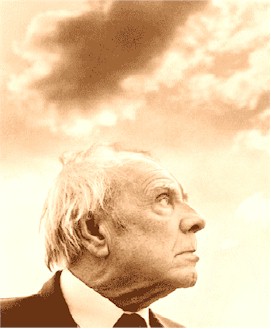
Perhaps it's ironic that Jorge Luis Borges, whose own stories tend to be concise and epigrammatic, should have one of his closest relationships documented in a massive volume the nearly equals his own collected works in size. Adolfo Bioy Casares was a friend and frequent collaborator for over 45 years; from 1947 until Borges' death in 1986, he also played Boswell to the great writer, transferring their almost daily conversations into a diary, a hefty portion of which has been published in Argentina. David Gallagher's review in the Times Literary Supplement plumbs the depths of this gossip-laden gold mine and suggests that 1,663 pages of literary small talk may be a little too much of a good thing.

See also: the Borges Center at the University of Iowa.

Tuesday, June 26, 2007

Back in her most dangerous adventure yet!

You're going to see it eventually. It might as well be here.
Good Cop, Baby Cop

Sunday, June 24, 2007

Saturday, June 23, 2007

Sicko

This world needs Michael Moore.

If you want to learn about how an individual community can be destroyed by an economic crisis, and about how badly the powers-that-be can behave when faced by the same thing, you can do no better that to watch Roger and Me.
If you have any doubts about the way the gun-loving cult takes advantage of personal tragedy and plays on fear and prejudice, you need to see Bowling For Columbine right away.
And there's no better account of the idiocy of the current administration than Fahrenheit 9/11.
But as much as I admire Moore's earlier films, I don't think any of them completely prepared me for his latest Sicko, a populist epic that needs to be seen by anybody who has or will find themselves lost in the health care morass of this country.
I can't imagine that anyone needs to be told that health insurance is a complicated, expensive, frustrating and time-consuming mess, and I initially thought that the idea of a film on the subject would be just as tedious as two hours of filling out forms and haggling over deductibles.
I was wrong. For the first 30 minutes, Sicko had me cringing and seething. And by the end, I was in tears. (Which is strange, really, because it actually ends with a pretty good joke...)
Moore's film is to a large degree a surprisingly warm and optimistic proposal about health care that really works: Patients getting reliable, affordable treatments. Doctors who are more concerned with their patients condition than their coverage (and even make house calls).
The problem is that Moore has to go a little bit out of his way to find these examples. Not just out of the way, but out of the country. To Canada. To England and France. To Cuba.
(It's that last leg of the trip, of course, that will most likely give folks an excuse to trash the film without addressing any of the issues it raises.)
It is hardly news that Moore has a gift for provocation, but what will stun people about Sicko most of all is that he has abandoned or at least seriously reined in much of his usual arsenal of tricks and tactics, the very things that have so frequently divided his critics. The big goofy innocent persona developed so skillfully in the opening segment of Roger and Me has become a quiet patient observer. The ambush interviewing tactics that have made some of his subjects call him unfair are absent. Even the offbeat, even whimsical sense of irony is held in check (though you have to give him credit for an ingenious use of the classic Serge Gainsbourg record "Je t'aime..moi nom plus".)
And strangest of all, Sicko is a film in which Moore has no real enemies to track down. Where his previous films have delighted in confronting bureaucrats, humiliating stuffy corporations and exposing hypocrites of every stripe, one gets the sense that here Moore has, of necessity, found a different way of looking at things. Yes, the insurance companies can be evil and Hilary Clinton made a mess of things, but Moore has found a bigger picture. He's critical of health industry abuses but more impressed by the idea that, with enough public support, health care could be made to work.
And that may be the thing that will drive Moore's enemies - the ones just waiting to leap out at the first misstep - absolutely nuts. (There are a lot of professional Moore-haters out there, one of which actually the subject of a surprising turn near the end of Sicko). Because unlike corporate greed, gun control or the Iraq War, Moore's film isn't about taking sides. We will all get sick, have accidents or produce babies, and Sicko is a powerful look at how we have gone about doing (and paying for) those things - and how we could do a lot better.

See Sicko immediately.
Visit Moore's website.
And be grateful that we have filmmakers/muckrakers/citizens like him.

(Update: 6/28/07. This review - really just a spontaneous outburst immediately after seeing the film - can also be found here at Playback. Thanks guys!)
Friday, June 22, 2007

New Hope, still featherless


While it seems to be fashionable to raise a critical nose to much of his current cinematic output (a tendency which I do not share, I must add), the arrival of a new collection of short pieces by Woody Allen - his first in over 25 years - is being welcomed as a Very Good Thing. The New York Observer lets Scott Eyman tell you why, while in Esquire, Mark Warren gets to the heart of the matter: Will it help you attract women?


Sunday, June 17, 2007

Tuesday, June 12, 2007

A Legend in his own mind...

By way of Bedazzled, here's information on Mingering Mike, a legendary soul singer who makes James Brown look like a slacker. "Hey Godfather, did you ever make 15 albums in a single year? Maybe they should call you the "Hardly-Working Man in Show Business"!"

Monday, June 11, 2007

Call me Rosebud

From filmmaker Alex Itin, via The Daily Reel, comes a very nice bit of video that combines two of my near-obsessions, Orson Welles and Herman Melville.
It seems to have something to do with Led Zeppelin as well....

Sunday, June 10, 2007

Comments: Something to do with death

It's the 25th anniversary of the death of Rainer Werner Fassbinder, a Pantheon figure if there ever was one, and GreenCine Daily sorts out the continuing controversy over his legacy.

I don't like making comments on films I haven't seen, and I doubt that I will be making an effort to catch up with Hostel: Part Two, but I respect the opinions of blogger Filmbrain and find his comments on the film well worth reading in these violent times...

Saturday, June 09, 2007

Sunday Morning Coming Down

I know people carry on about the ritual of devoting your Sunday morning to The New York Times, but I let my subscription go five years ago this month and I don't really miss it. I wonder if I'd feel the same way living in London with the many pleasures of The Guardian? Fortunately, it's available online. And today, for example, it offers features on:
John Cassavetes
the vastly underrated Alan Bates
"Radio On" director Chris Petit on road movies
Roky Erickson
The Gorillaz
and the incomparable Jarvis Cocker who isn't running the world yet, but has least taken control of the Meltdown Festival...

I'm already exhausted...

Spoiler Alert!


How many times do we have to tell you? Soylent Green is People!

I love this t-shirt guaranteed to irritate the Spoiler Police....


Previously spoiled items here.

Wednesday, June 06, 2007

Fascist Statement

It's one of the longest-running arguments in film history, second only to debates over the racism of D.W. Griffith's Birth of a Nation: Can you take the Nazi-loving content out of Leni Riefenstahl's films and admire them strictly for their formal virtuosity? The debate rages anew thanks to the publication of two new biographies of cinema's most fascinating fascist. The New York Review of Books offers Ian Buruma's analysis of them, and even raids the archives to post the 1975 Susan Sontag essay that rekindled the whole fire.


...and incidentally, if you want my opinion, the answer is: No.

Sunday, June 03, 2007

No, but I read the book...

Movies have been based on real events, operas, plays, tv shows, comic books, songs, video and board games, amusement park attractions, even bubblegum cards, but no form of adaptation remains as constantly controversial as that of the cinematic transformation of a novel. Some authors fret over the slightest alteration of their work, many others take the money and run. A small few have even learned not to worry about the issue at all, like William Gibson, who recently wrote (in a slightly different context) "I no longer get very wrought up over the liminals, myself, except to be annoyed by people who seem to assume that feature films are the ultimate stage of novelistic creation, thereby relegating the book to the status of dull gray chrysalis".
In the current Bookforum, Philip Lopate tracks the line between the written word and the celluloid frame and finds more to defend than to condemn. In sidebars, various literary and film folks tell their own experiences in seeing a work made cinematic and list a few notable adaptations.

Brief notes: Zizek, Cult directors unearthed

For those who can't get enough Slavoj Zizek, The Philosopher's Magazine offers a short and typically stream-of-consciousness outtake from a recent interview in which the critic/philosopher/amateur prophet chews on the subject of fundamentalism.

Ever wonder what happened to those filmmakers who made some modest impact and then disappeared into a rabbit hole so deep that only IMDB can find them? In The Guardian, Zoe Williams manages to track down Robin Hardy, director of The Wicker Man, and manages to politely ask just what he's been up to for the last 34 years. The answer: making money, writing novels and scoffing at his cultish reputation.

Alex Cox made a punkish splash in the 80s with Repo Man and Sid and Nancy, then almost willfully sabotaged his shot at breaking into the mainstream with the back-to-back raspberries of Walker (Hey Universal! I'm going to take all your money and give it to the Sandinistas!) and Straight to Hell (And then I'm gonna take even more of your money and spend it all on drink while my friends and I play cowboys out in the desert!). Cox still makes films - though U.S> distribution has been minimal - and has just put the wraps on something called Searchers 2.0 for Roger Corman. He's also a frequent talking head and columnist in the British media, holding forth on favorite subjects like Leone and Peckinpah. His wonderfully eccentric website offers film, politics and strong opinion, and you can even download his 1978 book on Spaghetti Westerns, "10,000 Ways to Die".

Saturday, June 02, 2007

Great moments in promotion:

From the top secret underground lair of super genius Ted Turner:


Posted by Picasa

The OutKast lunch box!

And in case you're wondering just what to put in Andre 3000's lunch, he's in the running for being named PETA's "Sexiest Vegetarian". Vote responsibly!

Saturday, May 19, 2007

All you need is...

It's the 40th anniversary of the Summer of Love. You know what they say: If you can remember it, you weren't there. And if you weren't there, you can read this lengthy look back courtesy of Peter Weir, Country Joe McDonald, Bob Weir and others, as recorded by Ed Vuliamy for the Guardian.
And more on the institutionalization of 1967, via the New York Times.

Friday, May 18, 2007

It's only fair.


Looking for an explanation of copyright that gets to the point while simultaneously forcing the whole "fair use" issue by deliberately exploiting the work of its biggest opponent? In this mash-up from the Media Education Foundation at Stanford, Woody, Buzz, Jasmine, Ariel and all their friends break away from their attorneys just long enough to explain it to you.

Sunday, February 25, 2007

Then and Now. And Later.

Using "Babel" as a starting point, David Denby has some interesting thoughts on the current popularity of non-sequential narrative in "The New Yorker". (Read it quick; it won't stay on line forever.)
By the way, I share his suspicion of "Babel", a film which pretends to a kind of humanism while depicting almost all human behavior (except that of his primary protagonists) as brutal, uncaring and suspicious.

Monday, February 19, 2007

Ryan Larkin


Green Cine Daily, Movie City News and several other places have already reported this, so I'm just passing it along. Ryan Larkin, the Canadian animator whose award winning "Walking" was an art-house staple in the 70s, and who was himself the subject of the brilliant and disturbing film "Ryan", has died of lung cancer. Those who have seen "Ryan" will be relieved to know that Larkin had managed to pull his life a little closer to normalcy in the last few years and had recently produced short "bumper" films for the Canadian version of MTV.
The obituary from "The Toronto Star" is Here.
You can watch "Walking" on the National Film Board of Canada site, read more and view clips at "Cartoon Brew" and see an excerpt from "Ryan" at Movie City News.

Sunday, February 18, 2007

All Yesterday's Parties

I've been trying for weeks to write something about George Hickenlooper's Factory Girl, but there's really nothing much to say about this lazy biography of Edie Sedgwick, which plays like a superficial, generations-removed-from-the-facts account of a life which leaned too heavily on the side of superficiality to begin with. You probably know the outline of the story, its cult like status due largely to the popularity of Jean Stein and George Plimpton's exhaustive 1982 oral history "Edie: An American Biography": Poor Little Rich Girlfalls in with the Andy Warhol crowd, becomes the Flavor of the Week but quickly makes a sharp descent into drugs and mental illness. It's a tragedy of sorts, but there's not enough in "Factory Girl" to overcome the film's gossip-driven "People Magazine" view of history.
Yes, there are entertaining moments. Sienna Miller provides many of them, even though the script often makes her sound like a bubble-headed freshman art student. Guy Pearce also has a few good scenes as enigmatic Warhol, but just as many in which the film simply has him mimic some of the artist's familiar tv appearances. Warhol utters some naive quip, Edie gushes about what great work he's doing and the filmmakers hope that creating a resemblance to an old photograph of the Factory crowd will pass for substance.
For a few scenes, it almost works (though the depiction of Warhol's film work is completely off-track)but the credibility factor is strained. That strain becomes completely and irrevocably unsalvageable with the appearance of Hayden Christensen as a character labeled only "Musician". (Earlier versions of the credits called him "Billy Quinn". Perhaps the change was intended to make him more mysterious, but I prefer to think that all of the world's real-life Billy Quinns raised an objection..) It doesn't take much more than a look at his album-cover inspired wardrobe to realize that he's a thinly disguised Bob Dylan, but Christensen seems to have gotten his Midwestern rebel icons all mixed up and falls into an confusing imitation of James Dean. To the degree that "Factory Girl" has a coherent storyline, it seems to be that "Musician" is the serpent to Edie's Eve, placing doubts in her mind about Warhol and causing the artist to banish her from his silver-lined Eden. (This may be a slight exaggeration of whatever real relationship existed between Sedgwick and Dylan; at any rate, it merits only two-and-a-half pages in the Stein and Plimpton book.) Once the bubble of the Warhol Sixties has popped, neither the film nor its version of Edie has anywhere to go but down.
The real Edie's decline was no less rapid, but it's been well-documented, not just in the Stein/Plimpton book but in "Ciao! Manhattan", a stoned mess of a film that she was working on in her final days. Completed after her death and released almost a decade later to benefit from the book's popularity, it's an unpleasantly exploitative film, but so blatant in its use of the brain-fried actress that it reveals as much about her sad end as you would probably ever want to know. It would be interesting to see it placed side by side with one of her Warhol performances, like "Poor Little Rich Girl", a lengthy close-up of the young woman rambling on about very little on a typical day at the height of her Factory career (It actually adds to the effect of the film that more than half of it was shot out of focus..). Exposed for the camera, these two films might serve as bookends to her short and unfortunate life, the Edie in her prime no less (or more) shallow than the stumbling, topless train-wreck of the final work.