From filmmaker Alex Itin, via The Daily Reel, comes a very nice bit of video that combines two of my near-obsessions, Orson Welles and Herman Melville.
It seems to have something to do with Led Zeppelin as well....
Monday, June 11, 2007


Sunday, June 10, 2007
Comments: Something to do with death
It's the 25th anniversary of the death of Rainer Werner Fassbinder, a Pantheon figure if there ever was one, and GreenCine Daily sorts out the continuing controversy over his legacy.
I don't like making comments on films I haven't seen, and I doubt that I will be making an effort to catch up with Hostel: Part Two, but I respect the opinions of blogger Filmbrain and find his comments on the film well worth reading in these violent times...
I don't like making comments on films I haven't seen, and I doubt that I will be making an effort to catch up with Hostel: Part Two, but I respect the opinions of blogger Filmbrain and find his comments on the film well worth reading in these violent times...
Saturday, June 09, 2007
Sunday Morning Coming Down
I know people carry on about the ritual of devoting your Sunday morning to The New York Times, but I let my subscription go five years ago this month and I don't really miss it. I wonder if I'd feel the same way living in London with the many pleasures of The Guardian? Fortunately, it's available online. And today, for example, it offers features on:
John Cassavetes
the vastly underrated Alan Bates
"Radio On" director Chris Petit on road movies
Roky Erickson
The Gorillaz
and the incomparable Jarvis Cocker who isn't running the world yet, but has least taken control of the Meltdown Festival...
I'm already exhausted...
John Cassavetes
the vastly underrated Alan Bates
"Radio On" director Chris Petit on road movies
Roky Erickson
The Gorillaz
and the incomparable Jarvis Cocker who isn't running the world yet, but has least taken control of the Meltdown Festival...
I'm already exhausted...
Spoiler Alert!

How many times do we have to tell you? Soylent Green is People!
I love this t-shirt guaranteed to irritate the Spoiler Police....
Previously spoiled items here.
Wednesday, June 06, 2007
Fascist Statement
It's one of the longest-running arguments in film history, second only to debates over the racism of D.W. Griffith's Birth of a Nation: Can you take the Nazi-loving content out of Leni Riefenstahl's films and admire them strictly for their formal virtuosity? The debate rages anew thanks to the publication of two new biographies of cinema's most fascinating fascist. The New York Review of Books offers Ian Buruma's analysis of them, and even raids the archives to post the 1975 Susan Sontag essay that rekindled the whole fire.
...and incidentally, if you want my opinion, the answer is: No.
...and incidentally, if you want my opinion, the answer is: No.
Sunday, June 03, 2007
No, but I read the book...
Movies have been based on real events, operas, plays, tv shows, comic books, songs, video and board games, amusement park attractions, even bubblegum cards, but no form of adaptation remains as constantly controversial as that of the cinematic transformation of a novel. Some authors fret over the slightest alteration of their work, many others take the money and run. A small few have even learned not to worry about the issue at all, like William Gibson, who recently wrote (in a slightly different context) "I no longer get very wrought up over the liminals, myself, except to be annoyed by people who seem to assume that feature films are the ultimate stage of novelistic creation, thereby relegating the book to the status of dull gray chrysalis".
In the current Bookforum, Philip Lopate tracks the line between the written word and the celluloid frame and finds more to defend than to condemn. In sidebars, various literary and film folks tell their own experiences in seeing a work made cinematic and list a few notable adaptations.
In the current Bookforum, Philip Lopate tracks the line between the written word and the celluloid frame and finds more to defend than to condemn. In sidebars, various literary and film folks tell their own experiences in seeing a work made cinematic and list a few notable adaptations.
Brief notes: Zizek, Cult directors unearthed
For those who can't get enough Slavoj Zizek, The Philosopher's Magazine offers a short and typically stream-of-consciousness outtake from a recent interview in which the critic/philosopher/amateur prophet chews on the subject of fundamentalism.
Ever wonder what happened to those filmmakers who made some modest impact and then disappeared into a rabbit hole so deep that only IMDB can find them? In The Guardian, Zoe Williams manages to track down Robin Hardy, director of The Wicker Man, and manages to politely ask just what he's been up to for the last 34 years. The answer: making money, writing novels and scoffing at his cultish reputation.
Alex Cox made a punkish splash in the 80s with Repo Man and Sid and Nancy, then almost willfully sabotaged his shot at breaking into the mainstream with the back-to-back raspberries of Walker (Hey Universal! I'm going to take all your money and give it to the Sandinistas!) and Straight to Hell (And then I'm gonna take even more of your money and spend it all on drink while my friends and I play cowboys out in the desert!). Cox still makes films - though U.S> distribution has been minimal - and has just put the wraps on something called Searchers 2.0 for Roger Corman. He's also a frequent talking head and columnist in the British media, holding forth on favorite subjects like Leone and Peckinpah. His wonderfully eccentric website offers film, politics and strong opinion, and you can even download his 1978 book on Spaghetti Westerns, "10,000 Ways to Die".
Ever wonder what happened to those filmmakers who made some modest impact and then disappeared into a rabbit hole so deep that only IMDB can find them? In The Guardian, Zoe Williams manages to track down Robin Hardy, director of The Wicker Man, and manages to politely ask just what he's been up to for the last 34 years. The answer: making money, writing novels and scoffing at his cultish reputation.
Alex Cox made a punkish splash in the 80s with Repo Man and Sid and Nancy, then almost willfully sabotaged his shot at breaking into the mainstream with the back-to-back raspberries of Walker (Hey Universal! I'm going to take all your money and give it to the Sandinistas!) and Straight to Hell (And then I'm gonna take even more of your money and spend it all on drink while my friends and I play cowboys out in the desert!). Cox still makes films - though U.S> distribution has been minimal - and has just put the wraps on something called Searchers 2.0 for Roger Corman. He's also a frequent talking head and columnist in the British media, holding forth on favorite subjects like Leone and Peckinpah. His wonderfully eccentric website offers film, politics and strong opinion, and you can even download his 1978 book on Spaghetti Westerns, "10,000 Ways to Die".
Saturday, June 02, 2007
Great moments in promotion:
From the top secret underground lair of super genius Ted Turner:


The OutKast lunch box!
And in case you're wondering just what to put in Andre 3000's lunch, he's in the running for being named PETA's "Sexiest Vegetarian". Vote responsibly!


The OutKast lunch box!
And in case you're wondering just what to put in Andre 3000's lunch, he's in the running for being named PETA's "Sexiest Vegetarian". Vote responsibly!
Saturday, May 19, 2007
All you need is...
It's the 40th anniversary of the Summer of Love. You know what they say: If you can remember it, you weren't there. And if you weren't there, you can read this lengthy look back courtesy of Peter Weir, Country Joe McDonald, Bob Weir and others, as recorded by Ed Vuliamy for the Guardian.
And more on the institutionalization of 1967, via the New York Times.
And more on the institutionalization of 1967, via the New York Times.
Friday, May 18, 2007
It's only fair.

Looking for an explanation of copyright that gets to the point while simultaneously forcing the whole "fair use" issue by deliberately exploiting the work of its biggest opponent? In this mash-up from the Media Education Foundation at Stanford, Woody, Buzz, Jasmine, Ariel and all their friends break away from their attorneys just long enough to explain it to you.
Sunday, February 25, 2007
Then and Now. And Later.
Using "Babel" as a starting point, David Denby has some interesting thoughts on the current popularity of non-sequential narrative in "The New Yorker". (Read it quick; it won't stay on line forever.)
By the way, I share his suspicion of "Babel", a film which pretends to a kind of humanism while depicting almost all human behavior (except that of his primary protagonists) as brutal, uncaring and suspicious.
By the way, I share his suspicion of "Babel", a film which pretends to a kind of humanism while depicting almost all human behavior (except that of his primary protagonists) as brutal, uncaring and suspicious.
Monday, February 19, 2007
Ryan Larkin

Green Cine Daily, Movie City News and several other places have already reported this, so I'm just passing it along. Ryan Larkin, the Canadian animator whose award winning "Walking" was an art-house staple in the 70s, and who was himself the subject of the brilliant and disturbing film "Ryan", has died of lung cancer. Those who have seen "Ryan" will be relieved to know that Larkin had managed to pull his life a little closer to normalcy in the last few years and had recently produced short "bumper" films for the Canadian version of MTV.
The obituary from "The Toronto Star" is Here.
You can watch "Walking" on the National Film Board of Canada site, read more and view clips at "Cartoon Brew" and see an excerpt from "Ryan" at Movie City News.
Sunday, February 18, 2007
All Yesterday's Parties
I've been trying for weeks to write something about George Hickenlooper's Factory Girl, but there's really nothing much to say about this lazy biography of Edie Sedgwick, which plays like a superficial, generations-removed-from-the-facts account of a life which leaned too heavily on the side of superficiality to begin with. You probably know the outline of the story, its cult like status due largely to the popularity of Jean Stein and George Plimpton's exhaustive 1982 oral history "Edie: An American Biography": Poor Little Rich Girlfalls in with the Andy Warhol crowd, becomes the Flavor of the Week but quickly makes a sharp descent into drugs and mental illness. It's a tragedy of sorts, but there's not enough in "Factory Girl" to overcome the film's gossip-driven "People Magazine" view of history.
Yes, there are entertaining moments. Sienna Miller provides many of them, even though the script often makes her sound like a bubble-headed freshman art student. Guy Pearce also has a few good scenes as enigmatic Warhol, but just as many in which the film simply has him mimic some of the artist's familiar tv appearances. Warhol utters some naive quip, Edie gushes about what great work he's doing and the filmmakers hope that creating a resemblance to an old photograph of the Factory crowd will pass for substance.
For a few scenes, it almost works (though the depiction of Warhol's film work is completely off-track)but the credibility factor is strained. That strain becomes completely and irrevocably unsalvageable with the appearance of Hayden Christensen as a character labeled only "Musician". (Earlier versions of the credits called him "Billy Quinn". Perhaps the change was intended to make him more mysterious, but I prefer to think that all of the world's real-life Billy Quinns raised an objection..) It doesn't take much more than a look at his album-cover inspired wardrobe to realize that he's a thinly disguised Bob Dylan, but Christensen seems to have gotten his Midwestern rebel icons all mixed up and falls into an confusing imitation of James Dean. To the degree that "Factory Girl" has a coherent storyline, it seems to be that "Musician" is the serpent to Edie's Eve, placing doubts in her mind about Warhol and causing the artist to banish her from his silver-lined Eden. (This may be a slight exaggeration of whatever real relationship existed between Sedgwick and Dylan; at any rate, it merits only two-and-a-half pages in the Stein and Plimpton book.) Once the bubble of the Warhol Sixties has popped, neither the film nor its version of Edie has anywhere to go but down.
The real Edie's decline was no less rapid, but it's been well-documented, not just in the Stein/Plimpton book but in "Ciao! Manhattan", a stoned mess of a film that she was working on in her final days. Completed after her death and released almost a decade later to benefit from the book's popularity, it's an unpleasantly exploitative film, but so blatant in its use of the brain-fried actress that it reveals as much about her sad end as you would probably ever want to know. It would be interesting to see it placed side by side with one of her Warhol performances, like "Poor Little Rich Girl", a lengthy close-up of the young woman rambling on about very little on a typical day at the height of her Factory career (It actually adds to the effect of the film that more than half of it was shot out of focus..). Exposed for the camera, these two films might serve as bookends to her short and unfortunate life, the Edie in her prime no less (or more) shallow than the stumbling, topless train-wreck of the final work.
Yes, there are entertaining moments. Sienna Miller provides many of them, even though the script often makes her sound like a bubble-headed freshman art student. Guy Pearce also has a few good scenes as enigmatic Warhol, but just as many in which the film simply has him mimic some of the artist's familiar tv appearances. Warhol utters some naive quip, Edie gushes about what great work he's doing and the filmmakers hope that creating a resemblance to an old photograph of the Factory crowd will pass for substance.
For a few scenes, it almost works (though the depiction of Warhol's film work is completely off-track)but the credibility factor is strained. That strain becomes completely and irrevocably unsalvageable with the appearance of Hayden Christensen as a character labeled only "Musician". (Earlier versions of the credits called him "Billy Quinn". Perhaps the change was intended to make him more mysterious, but I prefer to think that all of the world's real-life Billy Quinns raised an objection..) It doesn't take much more than a look at his album-cover inspired wardrobe to realize that he's a thinly disguised Bob Dylan, but Christensen seems to have gotten his Midwestern rebel icons all mixed up and falls into an confusing imitation of James Dean. To the degree that "Factory Girl" has a coherent storyline, it seems to be that "Musician" is the serpent to Edie's Eve, placing doubts in her mind about Warhol and causing the artist to banish her from his silver-lined Eden. (This may be a slight exaggeration of whatever real relationship existed between Sedgwick and Dylan; at any rate, it merits only two-and-a-half pages in the Stein and Plimpton book.) Once the bubble of the Warhol Sixties has popped, neither the film nor its version of Edie has anywhere to go but down.
The real Edie's decline was no less rapid, but it's been well-documented, not just in the Stein/Plimpton book but in "Ciao! Manhattan", a stoned mess of a film that she was working on in her final days. Completed after her death and released almost a decade later to benefit from the book's popularity, it's an unpleasantly exploitative film, but so blatant in its use of the brain-fried actress that it reveals as much about her sad end as you would probably ever want to know. It would be interesting to see it placed side by side with one of her Warhol performances, like "Poor Little Rich Girl", a lengthy close-up of the young woman rambling on about very little on a typical day at the height of her Factory career (It actually adds to the effect of the film that more than half of it was shot out of focus..). Exposed for the camera, these two films might serve as bookends to her short and unfortunate life, the Edie in her prime no less (or more) shallow than the stumbling, topless train-wreck of the final work.
Tuesday, January 02, 2007
Vice. Versa
Performance - which will be getting its long overdue DVD release shortly - is also the subject of this exhibit..
Tuesday, November 21, 2006

Sunday, November 19, 2006
One for now, one for later

It's hard to describe Guilermo del Toro's Pan's Labyrinth: It's a fairy tale for adults, a fantasy film about real-life monsters. It's a haunting film, and the more I think about it, the more I like it. I'll say more about it later, but for now think of Borges writing for the Muppets, with Bertolucci directing. Can't imagine that? Good, because that doesn't quite do it justice anyway. The Guardian offers a peek at some of the director's sketches and notebooks for this dreamlike film here.
And while it will probably be another year before we get to see it, a new film by Wong Kar-Wai is always a dreamy experience. His next, My Blueberry Nights, is an American road movie starring Jude Law, Natalie Portman and Norah Jones. The New York Times takes an advance look at the map.
Until then, here's two small tastes of WKW, the DJ Shadow music video "Six Days" and a very short commercial for Lacoste.
Sunday, November 12, 2006
Critical Voices
He can be infuriating, dogmatic, even a bit irrational, but there's little doubt that Robin Wood is one of the most important voices in film criticism, as much now as he was forty years ago. His books on Hitchcock and Hawks are essential contributions to auteurist thinking, his work on horror films (focusing on DePalma, Cronenberg and Cohen) set standards for ideology and genre-based criticism that have yet to be matched, and above all, his relentless honesty about his own life and his willingness to modify his positions over time are a model to anyone who expects criticism to be more than a breathless exclamatory quote for the benefit of film publicists. This brief but fascinating interview from "Your Flesh" offers a kind of "Beginner's Guide" to some of Wood's interests over the years. But don't stop there: If you haven't already read them, proceed immediately to the books below.
Friday, November 10, 2006
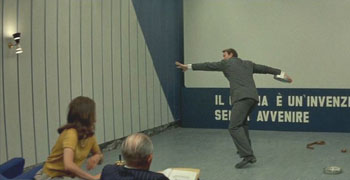
"A need for truth"
Moviegoers in New York (and later, Los Angeles and London) can take in a retrospective of the work of a cinematic master, Roberto Rossellini. The rest of us will just have to make do with the few available titles on video and this assessment by Manohla Dargis in the New York Times.
In Memoriam: Most of the obituaries of Fereydoun Hoveyda, who died a few days ago, make note only of his role as an Iranian diplomat, but film enthusiasts may remember him just as well as one of the founders of "Cahiers du Cinema" and one of its most enthusiastic contributors in the 1950s. This article from The Persian Mirror takes a closer look Hoveyda's critical skills and interest in the arts, and provides a link to this brief note on the roots of his cinephilia.
In Memoriam: Most of the obituaries of Fereydoun Hoveyda, who died a few days ago, make note only of his role as an Iranian diplomat, but film enthusiasts may remember him just as well as one of the founders of "Cahiers du Cinema" and one of its most enthusiastic contributors in the 1950s. This article from The Persian Mirror takes a closer look Hoveyda's critical skills and interest in the arts, and provides a link to this brief note on the roots of his cinephilia.
Sunday, November 05, 2006
It's only rock and roll...

...but the news that Martin Scorsese is working on a documentary/concert film about the Rolling Stones - and with documentary giant Albert Maysles (Gimme Shelter), no less - is pretty exciting. Scorsese's No Direction Home was pretty close to a masterpiece, but deliberately limited in its scope, focusing entirely on the first half of the 1960s and using the Dylan's conversion to electric music and the release of "Like a Rolling Stone" as a climax. I suspect that his affinity for the Stones and his gift for capturing live performances will push the new film in other directions. At any rate, this comes close to tying Todd Hayne's I'm Not There as the most interesting musical project of 2007.
Other musical diversions:
Is there really a statue of Willie Nelson in Nacogdoches TX, or is this just something they worked up for an album cover?
If it's for real, I want a whole carton of postcards.
And finally, two websites that have wasted a trickload of my time recently:
- Bedazzled! - it's like YouTube for people with eccentric tastes in old pop music.
- the official site for the Tenacious D movie - worth exploring at length, especially the "Satan's VCR" and "Rock The Internet" sections (though the latter was a bit slooooooowwwwww).
Subscribe to:
Posts (Atom)