Tuesday, January 02, 2007
Vice. Versa
Performance - which will be getting its long overdue DVD release shortly - is also the subject of this exhibit..


Tuesday, November 21, 2006

Sunday, November 19, 2006
One for now, one for later

It's hard to describe Guilermo del Toro's Pan's Labyrinth: It's a fairy tale for adults, a fantasy film about real-life monsters. It's a haunting film, and the more I think about it, the more I like it. I'll say more about it later, but for now think of Borges writing for the Muppets, with Bertolucci directing. Can't imagine that? Good, because that doesn't quite do it justice anyway. The Guardian offers a peek at some of the director's sketches and notebooks for this dreamlike film here.
And while it will probably be another year before we get to see it, a new film by Wong Kar-Wai is always a dreamy experience. His next, My Blueberry Nights, is an American road movie starring Jude Law, Natalie Portman and Norah Jones. The New York Times takes an advance look at the map.
Until then, here's two small tastes of WKW, the DJ Shadow music video "Six Days" and a very short commercial for Lacoste.
Sunday, November 12, 2006
Critical Voices
He can be infuriating, dogmatic, even a bit irrational, but there's little doubt that Robin Wood is one of the most important voices in film criticism, as much now as he was forty years ago. His books on Hitchcock and Hawks are essential contributions to auteurist thinking, his work on horror films (focusing on DePalma, Cronenberg and Cohen) set standards for ideology and genre-based criticism that have yet to be matched, and above all, his relentless honesty about his own life and his willingness to modify his positions over time are a model to anyone who expects criticism to be more than a breathless exclamatory quote for the benefit of film publicists. This brief but fascinating interview from "Your Flesh" offers a kind of "Beginner's Guide" to some of Wood's interests over the years. But don't stop there: If you haven't already read them, proceed immediately to the books below.
Friday, November 10, 2006
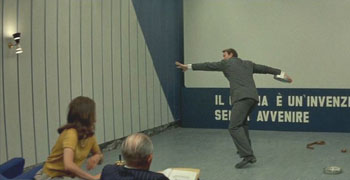
"A need for truth"
Moviegoers in New York (and later, Los Angeles and London) can take in a retrospective of the work of a cinematic master, Roberto Rossellini. The rest of us will just have to make do with the few available titles on video and this assessment by Manohla Dargis in the New York Times.
In Memoriam: Most of the obituaries of Fereydoun Hoveyda, who died a few days ago, make note only of his role as an Iranian diplomat, but film enthusiasts may remember him just as well as one of the founders of "Cahiers du Cinema" and one of its most enthusiastic contributors in the 1950s. This article from The Persian Mirror takes a closer look Hoveyda's critical skills and interest in the arts, and provides a link to this brief note on the roots of his cinephilia.
In Memoriam: Most of the obituaries of Fereydoun Hoveyda, who died a few days ago, make note only of his role as an Iranian diplomat, but film enthusiasts may remember him just as well as one of the founders of "Cahiers du Cinema" and one of its most enthusiastic contributors in the 1950s. This article from The Persian Mirror takes a closer look Hoveyda's critical skills and interest in the arts, and provides a link to this brief note on the roots of his cinephilia.
Sunday, November 05, 2006
It's only rock and roll...

...but the news that Martin Scorsese is working on a documentary/concert film about the Rolling Stones - and with documentary giant Albert Maysles (Gimme Shelter), no less - is pretty exciting. Scorsese's No Direction Home was pretty close to a masterpiece, but deliberately limited in its scope, focusing entirely on the first half of the 1960s and using the Dylan's conversion to electric music and the release of "Like a Rolling Stone" as a climax. I suspect that his affinity for the Stones and his gift for capturing live performances will push the new film in other directions. At any rate, this comes close to tying Todd Hayne's I'm Not There as the most interesting musical project of 2007.
Other musical diversions:
Is there really a statue of Willie Nelson in Nacogdoches TX, or is this just something they worked up for an album cover?
If it's for real, I want a whole carton of postcards.
And finally, two websites that have wasted a trickload of my time recently:
- Bedazzled! - it's like YouTube for people with eccentric tastes in old pop music.
- the official site for the Tenacious D movie - worth exploring at length, especially the "Satan's VCR" and "Rock The Internet" sections (though the latter was a bit slooooooowwwwww).
Saturday, November 04, 2006
Charlie Chaplin to D.W. Griffith: "I don't know about you, but I'm starting to get dizzy"

From a much-reprinted press release earlier this week:
"Tom and Paula are the modern versions of the iconic founders of United Artists - Douglas Fairbanks, Mary Pickford, Charlie Chaplin and D. W. Griffith - and our partnership with them reaffirms our commitment to providing creative talent with a comfortable home at United Artists and a dedicated distribution partner in MGM. United Artists is once again the haven for independent filmmakers and a vital resource in developing quality filmed entertainment consistent with MGM's modern studio model."
All of which suggests a grest new game: What contemporary celebrities can be lauded as inappropriate equivalents to silent stars?
Jennifer Aniston is the modern Clara Bow.
Paris Hilton is the modern Greta Garbo.
Madonna is the modern Nazimova.
The Wayans Brothers are the modern Laurel and Hardy.
Any contributions defining the modern Buster Keaton, William S. Hart, Louise Brooks, Gloria Swanson or Fatty Arbuckle are welcome.
Wednesday, November 01, 2006
Exercise your right to vote...
Sunday, October 22, 2006
What so proudly we hail...
Clint Eastwood’s devastating Flags of Our Fathers isn’t really a war movie. Or more precisely, it’s much more than a war movie. It’s a meditation on war, on the gap between the nightmarish events experienced by those who fight and the superficial imagery that those outside of war manipulate in the name of politics and patriotism.
It’s the story of an image, the famous photo of American soldiers raising the flag at Iwo Jima: You’ve seen the picture a thousand times but the ideas behind it – the heroism that you might have taken for granted, just as awestruck observers did when it turned up on every front page back in 1944 - are far more complicated. Used as a symbol of the final rush to victory at the end of World War Two, it’s a powerful icon. But as this film shows, it remains just a symbol, and the gap between that familiar but faceless group struggling with a flagpole and the real lives of the six men in the photo is bitter and heartbreaking.
That Eastwood is a masterful director is no surprise to anyone who’s followed his career, but as he gracefully allowed his own career as an actor to take a backseat, he is becoming increasingly ambitious, backing away from conventional narratives and allowing his films to breathe with their own sense of rhythm and environment. Just as Million Dollar Baby started out as a sports movie and trapped the audience into experiencing something far more deep and disturbing, Flags of Our Fathers starts with a few familiar notes from war movies and nostalgia, but they’re just part of a subtle plan to strip the glamour from the victory rallies and photo opportunities and reveal the real aftermath of war on the men who fought it. Just as his last film considered life and death with insight and depth but without a trace of sentimentality, Eastwood raises issues about war and heroism that few other filmmakers dare to approach.
It’s the story of an image, the famous photo of American soldiers raising the flag at Iwo Jima: You’ve seen the picture a thousand times but the ideas behind it – the heroism that you might have taken for granted, just as awestruck observers did when it turned up on every front page back in 1944 - are far more complicated. Used as a symbol of the final rush to victory at the end of World War Two, it’s a powerful icon. But as this film shows, it remains just a symbol, and the gap between that familiar but faceless group struggling with a flagpole and the real lives of the six men in the photo is bitter and heartbreaking.
That Eastwood is a masterful director is no surprise to anyone who’s followed his career, but as he gracefully allowed his own career as an actor to take a backseat, he is becoming increasingly ambitious, backing away from conventional narratives and allowing his films to breathe with their own sense of rhythm and environment. Just as Million Dollar Baby started out as a sports movie and trapped the audience into experiencing something far more deep and disturbing, Flags of Our Fathers starts with a few familiar notes from war movies and nostalgia, but they’re just part of a subtle plan to strip the glamour from the victory rallies and photo opportunities and reveal the real aftermath of war on the men who fought it. Just as his last film considered life and death with insight and depth but without a trace of sentimentality, Eastwood raises issues about war and heroism that few other filmmakers dare to approach.
Tuesday, October 17, 2006
Random Notes
When word leaked out that Andrew Lloyd Webber had been trying to get Scarlett Johannson to star in a revival of "The Sound of Music", I was a little surprised. Can she sing? And even if she can, does she really want to risk comparisons with the multi-octave range of Julie Andrews? This week, however, interest in Ms. Johannson's musical talents returned with the news of a record deal. The first release (which makes me laugh every time I think about it): "Scarlett Johannson sings Tom Waits".
Most of the obituaries for writer Jerry Belson stress - and rightly so - his work on the likes of "The Dick Van Dyke Show" and "The Tracey Ullman Show", both of which deserve their reputations. But I'd also put in a word for two small comic gems Belson wrote for the big screenin the 1970s, Michael Ritchie's Smile, and Burt Reynolds' underrated (in fact, practically unknown) The End. (I could probably add a third Evil Roy Slade, a rare gag-oriented made-for-tv movie.)
Wonkette reports that the Leader of the Free World (TM) watched two movies at Camp David thsi weekend: Talladega Nights: The Story of Ricky Bobby and Jackass 2. I tried to find a news report confirming this, but..well, you just see what happens when you do a Google search containing "President Bush" and "Jackass".
Most of the obituaries for writer Jerry Belson stress - and rightly so - his work on the likes of "The Dick Van Dyke Show" and "The Tracey Ullman Show", both of which deserve their reputations. But I'd also put in a word for two small comic gems Belson wrote for the big screenin the 1970s, Michael Ritchie's Smile, and Burt Reynolds' underrated (in fact, practically unknown) The End. (I could probably add a third Evil Roy Slade, a rare gag-oriented made-for-tv movie.)
Wonkette reports that the Leader of the Free World (TM) watched two movies at Camp David thsi weekend: Talladega Nights: The Story of Ricky Bobby and Jackass 2. I tried to find a news report confirming this, but..well, you just see what happens when you do a Google search containing "President Bush" and "Jackass".
Sunday, October 08, 2006
Don't call it a comeback.
Forget all of the silly “comeback” pieces – they’re the province of unimaginative journalists and editors who believe that their primary audience is composed of trend-chasing 24 year olds. The pleasures of The Departed come from Scorsese doing what he has always done best, telling a complex story (in terms of psychology as well as narrative) with a cinematic style that lives up to the medium’s name: moving pictures. It’s fast, sometimes confusing (but in a way that encourages multiple viewings) and unsparingly bleak in its portrayal of corruption and evil. Evil, as it happens, is the central theme of Scorsese’s film, and if you’re thinking that there’s a happy ending that which redeem anyone – from the devilish mob boss played by Jack Nicholson to the twin pairs of moles – a cop pretending to be a hood and a hood pretending to be a cop – played by Leonardo DiCaprio and Matt Damon – well, you’ve got the wrong picture. I won’t give away plot points: if you’ve seen Infernal Affairs, it’s a surprisingly faithful remake, but with a better grip on the psychological pressures that turn these two warring moles into near-psychotic adversaries. Why worry about comparing it to Goodfellas or Casino or anything else? It’s a serious work from a major film artist. That’s not good enough for you?
A brief and somewhat fatuous interview with Scorsese can be found here.
A brief and somewhat fatuous interview with Scorsese can be found here.
Saturday, October 07, 2006
After Shock
Belatedly turning up on video this week after making the festival rounds in 2004, Wim Wenders’ Land of Plenty has the feel of his more off-the-cuff pictures like Lisbon Story or Alice in the Cities, but its subject – the after-effects of the World Trade Center bombing - give it a searing significance that belies the off-key slightness of the narrative. Like The Million Dollar Hotel and The End of Violence, it uses a decaying Los Angeles as a symbol for a confused and bankrupt culture, but it’s also something of a road movie, a quest for answers in this violent and paranoid time. It’s about two crossed paths: Lana (Michelle William) is a young woman returning from a stay in Palestine to work in a downtown homeless shelter. Her uncle Paul (John Diehl, who gives an almost indescribably good performance) is her sole relative in the area, but he’s reluctant to make much of a connection; he prefers to spend his time cruising the streets in his van like Travis Bickle starring in a one-man version of The Conversation, taking part in an electronic network of paranoiacs keeping tabs on Arabs and other non-Americans. Despite being at cross purposes, the murder of a homeless Middle Eastern man brings uncle and niece together and they try to learn the victim's identity and return him to a suitable resting place. Do they find a common ground? Answers? Not really, but if you're among those who think this country went just a little bit crazy five years ago, you'll admire Land of Plenty for the questions it raises about these nervous times.
View the trailer here.
Speaking of Wenders, he recently took part in some sort of international think-tank called Dropping Knowledge, the Global Dialog Platform. Find out more here.
And for more video – on a much lighter note, Lemony Snicket channels Bob Dylan in this short video reminding us that The End is near – just six days away, in fact.
View the trailer here.
Speaking of Wenders, he recently took part in some sort of international think-tank called Dropping Knowledge, the Global Dialog Platform. Find out more here.
And for more video – on a much lighter note, Lemony Snicket channels Bob Dylan in this short video reminding us that The End is near – just six days away, in fact.
Sunday, September 24, 2006
...and apropos of nothing
... except that I thought it was funny, I was looking at a list of torrent files and found one that included a selection of old r and b recordings, including, it said, "Mr. H. Melville, acc. by the Blue Notes."
If you don't know me by now, call me Ishmael.
If you don't know me by now, call me Ishmael.
Learning to SMiLE
There are already many books (and movies and magazine articles) about Brian Wilson and the Beach Boys, all of them strangely incomplete – not just in the way that any biography of a still-living figure tends to be unfinished, but in a larger sense, as if the subject escaping from the writer. Wilson’s ghost-written but highly readable autobiography Wouldn’t It Be Nice?” suggested a newly revived hero – the subject is healthier than he’s ever been and, more importantly, is even recording again – but it’s now largely discredited due to the influence of the Svengali-like therapist Eugene Landy, who controlled Wilson’s every waking moment and even forcing himself as co-writer on his songs. Most other accounts seem to love sight of Wilson and the other band members somewhere around the 1976 “Brian is Back” campaign, summarizing the subsequent years through well known public events (lawsuits, etc. ) and chart all corporation selling nostalgia and the California dream to an increasingly complacent audience of Baby Boomers. With fewer traces of the original group remaining (Brian is the last surviving Wilson brother, Al Jardine left the group and tours with a Beach Boys cover-band called Family and Friends; the act currently performing as The Beach Boys has only one original member, Mike Love, along with frequent collaborator Bruce Johnston), Carlin has a better grasp of the business decisions and economic issues that have shaped most of their output in the last 30 years.
It’s not always a very pretty story, but Carlin is lucky to have come in when he did. With the release of “Smile”, the great mystery in the Brian Wilson story, the gap in every previous account, has been solved – and turns out to have been worth the wait. Though the composer is still obviously a very troubled man – see the excellent documentary “Beautiful Dreamer” for evidence – he has surprised many by becoming a successful live performer with a touring band which he regularly – and accurately – describes as far superior to his former co-players. After having been swallowed up by fame, fortune and his own musical legacy, Wilson has miraculously come out on top, giving Carlin’s book something that previous biographers would never have imagined: a happy ending.
It’s not always a very pretty story, but Carlin is lucky to have come in when he did. With the release of “Smile”, the great mystery in the Brian Wilson story, the gap in every previous account, has been solved – and turns out to have been worth the wait. Though the composer is still obviously a very troubled man – see the excellent documentary “Beautiful Dreamer” for evidence – he has surprised many by becoming a successful live performer with a touring band which he regularly – and accurately – describes as far superior to his former co-players. After having been swallowed up by fame, fortune and his own musical legacy, Wilson has miraculously come out on top, giving Carlin’s book something that previous biographers would never have imagined: a happy ending.
Jean-Luc Culture Godard

One of the major cultural events of the year, at least as far as folks in Europe are concerned, is Jean-Luc Godard's massive retrospective/installation "Travels in Utopia" at the Pompidou Centre in Paris. These articles in Senses of Cinema and Rouge jump right into it, while this fairly exhaustive photo gallery helps set the tone. Rouge also provides the introduction to the exhibition catalogue.
Needless to say, the whole thing sounds exhaustive and stimulating and frustrating and brilliant - just like most of Uncle Jean's output for the last few decades!
Sunday, September 17, 2006
Murder a la Mod: Brian DePalma still splits screens and opinions; Lemony Snicket faces The End
With the release of The Black Dahlia unlikely to change any sides, Slant Magazine takes a long retrospective look at the career of Brian DePalma, as does The New York Times.
And with less than a month before the final installment of A Series of Unfortunate Events (The 13th volume, The End, will be published on October 13th - a Friday, of course), author Lemony Snicket has been keeping busy with a few related projects, the recently-published The Beatrice Letters and a forthcoming album of grim songs by The Gothic Archies. The Guardian offers this conversation between Snicket and his collaborator Stephin Merritt of the Magnetic Stripes.
And with less than a month before the final installment of A Series of Unfortunate Events (The 13th volume, The End, will be published on October 13th - a Friday, of course), author Lemony Snicket has been keeping busy with a few related projects, the recently-published The Beatrice Letters and a forthcoming album of grim songs by The Gothic Archies. The Guardian offers this conversation between Snicket and his collaborator Stephin Merritt of the Magnetic Stripes.
Same player, new game
When we last saw Griffin Mill, he was sitting on top of the world with a beautiful wife, a great job and a flawless reputation. Sure, he’d murdered a guy, but nobody knew about that and the people in his line of work were too concerned with their own day-to-day survival to let a simple thing like that stir up too much of a fuss. Michael Tolkin's The Return of the Player again takes the reader into the mind of the amoral Mill, whose dealings at the top levels of Hollywood were the subject of both the 1988 predecessor and Robert Altman's ingenious 1992 adaptation. But nearly two decades later, Mill's path has changed. The dramas of marriage, divorce, parenthood and the economic and cultural changes of the period have changed Griffin.
Well, not really; he's as ruthless and self-centered as ever, but his targets have shifted. While his children seethe with anger, his wife breaks down over their crumbling marriage and his ex-wife June (whom he seduced after killing her boyfriend in the earlier novel), inspired by a visit to a Mormon church, develops a private religion in which she and Griffin are still married for eternity, Mill loses his place in Hollywood and goes after bigger targets by aligning himself with one of the richest and most powerful men in the world... who, as it turns out, is equally obsessed with someone even richer and more powerful than himself.
Cut loose from the security of his job, desparate to secure a place in the world of new media (and with another murder - sort of - under his belt), Griffin relies on the only skill that held him together in the studio boardroom, an ability to interpret film pitches through the design of the Hero's Journey a la Joseph Campbell. While the first novel stayed mainly in one environment, the insular world of Hollywood power, the sequel sends Mill into a less definable and more dream-like world ruled by manipulative and nearly invisible barons. His family life disintegrating and his grip on reality never quite certain, Mill's quest for power - which climaxes with an encounter with a real-life public figure I won't name - is not entirely as convincing but in some ways darker and more surreal than in the first novel. Some reviews are already citing Highsmith's Ripley novels as an inspiration (Tolkin even throws in a reference to Purple Noon, incase you miss the connection, but I'm not sure that Tolkin is planning a third volume. The Return of the Player, though not as neat as the first novel, takes a wild flight into the future, where Griffin may well have passed us all.
Tolkin discusses the novel in the current Bookforum.
d
Monday, September 11, 2006
More Warhol, Susan Sontag's diary:
More on Andy Warhol from The Guardian, as David Cronenberg comments on an exhibition he's curated.
Susan Sontag kept a journal....sort of. Sex. Gossip. Lists. It won't be published for another year or two, but The New York Times takes an early peek at her diary. The strangest part? How about that list of West Coast rock bands?
Susan Sontag kept a journal....sort of. Sex. Gossip. Lists. It won't be published for another year or two, but The New York Times takes an early peek at her diary. The strangest part? How about that list of West Coast rock bands?
Sunday, September 10, 2006
Good Evening...
They were two of the most oddly charismatic figures I’ve ever seen on a stage, this comically mismatched pair. One was tall, thin, and absolutely reeked of upper-class British self-contentment, even when it was just an act. The other was short, congenial, the very model of a comic foil. With nothing but the barest necessities in the way of props and lighting, they took one of the most meager forms of theatre – two-man sketch comedy – and came up with vivid bits of absurd theatre conjuring up a world in which the most unlikely premises, from the visitation of the Magi to a one-legged man auditioning for the role of Tarzan – were greeted with deadpan familiarity.
According to William Cook (no relation), who has compiled two books of their material, audiences in England - depending on their age - best remember Peter Cook and Dudley Moore as either “Pete and Dud”, a pair of affable dunces they played on their tv series “Not Only…But Also” in the 1960s, or “Derek and Clive”, the foul-mouthed and filthy-minded stars of a semi-underground recording made in the 70s. Their gift, he argues, was with sketch comedy, and unfortunately the majority of their work was unceremoniously erased by the BBC in order to conserve videotape. Curiously, Cook (the editor of the books) argues that prior to Dudley Moore’s brief standing as a film star in the US, movies were not a good medium for them, but I disagree. If they had never done anything other than Bedazzled, - high on my list of movies shamefully unavailable on DVD – they’d still be remembered as one of the funniest film partnerships in history.
I was fortunate enough to see Cook and Moore in 1975 when they toured the U.S. with “Good Evening” (The original title in other countries was “Behind the Fridge”, a waiter’s mangling of their first triumph “Beyond the Fringe”), the show that contained, in my opinion, many of their best sketches: “The Frog and Peach”, in which Sir Arthur Streeb-Greebling explains in his best stiff-upper-lip fashion why his venture in the restaurant business – the name also describes the menu- was a failure; “One Leg Too Few”, in which the above-mentioned would-be Tarzan – Moore bouncing merrily on one leg- would frequently crack his partner up with his giddy optimism ; and my favorite, the opening scene in which two men exchange pleasantries on the street while gradually coming to the realization that they’ve never met before.
PC: Hello.
DM: Hello.
PC: How are you?
DM: I’m terribly well! How are you?
PC: I’m terribly well as well!
DM: I must say you’re looking very fit.
PC: I’m feeling pretty fit actually. Isn’t it amazing – us just bumping into each other like this?
DM: Yes. I mean here of all places.
PC: Here of all places! I mean, I haven’t seen you since…er
DM: Now, er..hold on a minute..er, when was it? Er, we..we haven’t seen each other..
PC: Well actually we haven’t seen each other..
DM: We haven’t seen each other…er… before.
PC: That’s right. We’ve never seen each other before, have we?
DM: NO.
PC: You’ve never seen me.
DM: And I’ve never seen you. What a small world!
And so it goes as they continue to compare notes on family and acquaintances, in every case, finally agreeing that they must get together again soon.
One of the most unique things about Cook and Moore, as Cook (the editor, again) points out, was that their sketches are vitalized by the sheer pleasure they seem to have in working together. While Moore frequently plays the straight man, the energy behind much of their work (like the “Pete and Dud” sketches) comes from the collaboration of the two, stepping on each others lines, reworking and twisting the dialogue simultaneously. At their best, they played off of each other brilliantly, the comic effects materializing from their joint wordplay. Enjoying each others company (the exception of “One Leg Too Few”, it was usually Moore who would lose it on stage), they fix upon an idea, subject it to their fits of fantasy and then quickly make a joint getaway.
Sadly, the pair broke up not long after “Good Evening”. Moore had a brief fling as a film star, made some poor choices and briefly returned to his real love, music, before succumbing to a debilitating variant of Parkinson’s Disease. Cook became increasingly uninterested in performing for the public: In his final days, his best material was delivered in the form of late-night phone calls to a radio host. Both died too young, never really recognized for their talents. Reading their sketches in the two books below, it might be hard to see exactly what made them work. It helps if you can hear their voices or see their mismatched physical presence. (Even an almost purely verbal sketch like “The Frog and Peach” was given touches of physical comedy on stage with an elaborate series of leg-crossings that emphasized the difference in physique between the pair.) But if you’re fortunate enough to have seen them on some old videotape, or in any of their scenes together in Bedazzled – can I mention again what a shame it is that 20th Century Fox will not release this film? – and can fill in the blanks, these are invaluable mementos of two great comic minds, half scripted, half improvised, playing together.
According to William Cook (no relation), who has compiled two books of their material, audiences in England - depending on their age - best remember Peter Cook and Dudley Moore as either “Pete and Dud”, a pair of affable dunces they played on their tv series “Not Only…But Also” in the 1960s, or “Derek and Clive”, the foul-mouthed and filthy-minded stars of a semi-underground recording made in the 70s. Their gift, he argues, was with sketch comedy, and unfortunately the majority of their work was unceremoniously erased by the BBC in order to conserve videotape. Curiously, Cook (the editor of the books) argues that prior to Dudley Moore’s brief standing as a film star in the US, movies were not a good medium for them, but I disagree. If they had never done anything other than Bedazzled, - high on my list of movies shamefully unavailable on DVD – they’d still be remembered as one of the funniest film partnerships in history.
I was fortunate enough to see Cook and Moore in 1975 when they toured the U.S. with “Good Evening” (The original title in other countries was “Behind the Fridge”, a waiter’s mangling of their first triumph “Beyond the Fringe”), the show that contained, in my opinion, many of their best sketches: “The Frog and Peach”, in which Sir Arthur Streeb-Greebling explains in his best stiff-upper-lip fashion why his venture in the restaurant business – the name also describes the menu- was a failure; “One Leg Too Few”, in which the above-mentioned would-be Tarzan – Moore bouncing merrily on one leg- would frequently crack his partner up with his giddy optimism ; and my favorite, the opening scene in which two men exchange pleasantries on the street while gradually coming to the realization that they’ve never met before.
PC: Hello.
DM: Hello.
PC: How are you?
DM: I’m terribly well! How are you?
PC: I’m terribly well as well!
DM: I must say you’re looking very fit.
PC: I’m feeling pretty fit actually. Isn’t it amazing – us just bumping into each other like this?
DM: Yes. I mean here of all places.
PC: Here of all places! I mean, I haven’t seen you since…er
DM: Now, er..hold on a minute..er, when was it? Er, we..we haven’t seen each other..
PC: Well actually we haven’t seen each other..
DM: We haven’t seen each other…er… before.
PC: That’s right. We’ve never seen each other before, have we?
DM: NO.
PC: You’ve never seen me.
DM: And I’ve never seen you. What a small world!
And so it goes as they continue to compare notes on family and acquaintances, in every case, finally agreeing that they must get together again soon.
One of the most unique things about Cook and Moore, as Cook (the editor, again) points out, was that their sketches are vitalized by the sheer pleasure they seem to have in working together. While Moore frequently plays the straight man, the energy behind much of their work (like the “Pete and Dud” sketches) comes from the collaboration of the two, stepping on each others lines, reworking and twisting the dialogue simultaneously. At their best, they played off of each other brilliantly, the comic effects materializing from their joint wordplay. Enjoying each others company (the exception of “One Leg Too Few”, it was usually Moore who would lose it on stage), they fix upon an idea, subject it to their fits of fantasy and then quickly make a joint getaway.
Sadly, the pair broke up not long after “Good Evening”. Moore had a brief fling as a film star, made some poor choices and briefly returned to his real love, music, before succumbing to a debilitating variant of Parkinson’s Disease. Cook became increasingly uninterested in performing for the public: In his final days, his best material was delivered in the form of late-night phone calls to a radio host. Both died too young, never really recognized for their talents. Reading their sketches in the two books below, it might be hard to see exactly what made them work. It helps if you can hear their voices or see their mismatched physical presence. (Even an almost purely verbal sketch like “The Frog and Peach” was given touches of physical comedy on stage with an elaborate series of leg-crossings that emphasized the difference in physique between the pair.) But if you’re fortunate enough to have seen them on some old videotape, or in any of their scenes together in Bedazzled – can I mention again what a shame it is that 20th Century Fox will not release this film? – and can fill in the blanks, these are invaluable mementos of two great comic minds, half scripted, half improvised, playing together.
Subscribe to:
Posts (Atom)