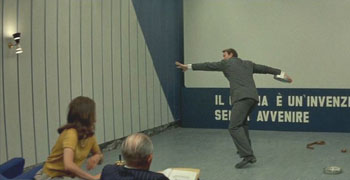
... as we search for the first real tear of love." So wrote Norman Mailer 37 years ago in explaining why he had made a brief and courageous entry into the world of cinema, In one of the most unexpected retrospectives of the year, New York's Walter Reade Theater and the Film Society of Lincoln Center are hosting a long overdue revival of the great writer's journey behind the camera, with screenings of all four of his films as well as frequent collaborator Lawrence Schiller's adaptation of "The Executioner's Song". (What? No King Lear? The current Film Comment offers an interview with Mailer and, from their archives, a report on Tough Guys Don't Dance, the most underrated of the late-80s cycle of pseudo-noir.
Tuesday, July 10, 2007
"We search for the pure in film...
... as we search for the first real tear of love." So wrote Norman Mailer 37 years ago in explaining why he had made a brief and courageous entry into the world of cinema, In one of the most unexpected retrospectives of the year, New York's Walter Reade Theater and the Film Society of Lincoln Center are hosting a long overdue revival of the great writer's journey behind the camera, with screenings of all four of his films as well as frequent collaborator Lawrence Schiller's adaptation of "The Executioner's Song". (What? No King Lear? The current Film Comment offers an interview with Mailer and, from their archives, a report on Tough Guys Don't Dance, the most underrated of the late-80s cycle of pseudo-noir.
Sicko: getting a second opinion
While not quite hitting the level of controversy of Fahrenheit 9/11, Michael Moore's Sicko is predictably being attacked for ...the usual reasons. Moore is putting up a defense on his website, with a rebuttal to a CNN report on the film, documentation of some of the film's statistics and, of even greater interest, a leaked memo from a BlueCross executive acknowledging the film's persuasiveness. Best quote: "You would have to be dead to be unaffected by Moore's movie."
And for a (slightly) dissenting view on Moore, Stuart Klawans offers a review in Film Comment.
Monday, July 09, 2007
Some movies are more equal than others...
The Halas and Batchelor version of George Orwell's "Animal Farm" has never been regarded as anything more than mundane adaptation, the sort of thing that English teachers would show to help students get through their required reading. But it may have been produced with entirely different intentions, as J. Hoberman explains in the current London Review of Books.
You can see for yourself here:
This is the first of 8 segments, You can find 2 - 7 here.
Friday, June 29, 2007
"What does vulgar mean anyway?"
Happy 80th Birthday to Ken Russell!
Sight and Sound offers an admiration of his work; I'll just sit back and try to imagine what a party at Ken Russell's house would be like.
Thursday, June 28, 2007
Inside the Labyrinth: Tours given daily.
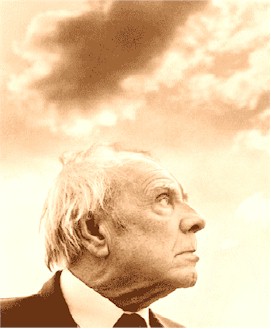
Perhaps it's ironic that Jorge Luis Borges, whose own stories tend to be concise and epigrammatic, should have one of his closest relationships documented in a massive volume the nearly equals his own collected works in size. Adolfo Bioy Casares was a friend and frequent collaborator for over 45 years; from 1947 until Borges' death in 1986, he also played Boswell to the great writer, transferring their almost daily conversations into a diary, a hefty portion of which has been published in Argentina. David Gallagher's review in the Times Literary Supplement plumbs the depths of this gossip-laden gold mine and suggests that 1,663 pages of literary small talk may be a little too much of a good thing.
See also: the Borges Center at the University of Iowa.
Tuesday, June 26, 2007
Back in her most dangerous adventure yet!
Sunday, June 24, 2007
Saturday, June 23, 2007
Sicko
If you want to learn about how an individual community can be destroyed by an economic crisis, and about how badly the powers-that-be can behave when faced by the same thing, you can do no better that to watch Roger and Me.
If you have any doubts about the way the gun-loving cult takes advantage of personal tragedy and plays on fear and prejudice, you need to see Bowling For Columbine right away.
And there's no better account of the idiocy of the current administration than Fahrenheit 9/11.
But as much as I admire Moore's earlier films, I don't think any of them completely prepared me for his latest Sicko, a populist epic that needs to be seen by anybody who has or will find themselves lost in the health care morass of this country.
I can't imagine that anyone needs to be told that health insurance is a complicated, expensive, frustrating and time-consuming mess, and I initially thought that the idea of a film on the subject would be just as tedious as two hours of filling out forms and haggling over deductibles.
I was wrong. For the first 30 minutes, Sicko had me cringing and seething. And by the end, I was in tears. (Which is strange, really, because it actually ends with a pretty good joke...)
Moore's film is to a large degree a surprisingly warm and optimistic proposal about health care that really works: Patients getting reliable, affordable treatments. Doctors who are more concerned with their patients condition than their coverage (and even make house calls).
The problem is that Moore has to go a little bit out of his way to find these examples. Not just out of the way, but out of the country. To Canada. To England and France. To Cuba.
(It's that last leg of the trip, of course, that will most likely give folks an excuse to trash the film without addressing any of the issues it raises.)
It is hardly news that Moore has a gift for provocation, but what will stun people about Sicko most of all is that he has abandoned or at least seriously reined in much of his usual arsenal of tricks and tactics, the very things that have so frequently divided his critics. The big goofy innocent persona developed so skillfully in the opening segment of Roger and Me has become a quiet patient observer. The ambush interviewing tactics that have made some of his subjects call him unfair are absent. Even the offbeat, even whimsical sense of irony is held in check (though you have to give him credit for an ingenious use of the classic Serge Gainsbourg record "Je t'aime..moi nom plus".)
And strangest of all, Sicko is a film in which Moore has no real enemies to track down. Where his previous films have delighted in confronting bureaucrats, humiliating stuffy corporations and exposing hypocrites of every stripe, one gets the sense that here Moore has, of necessity, found a different way of looking at things. Yes, the insurance companies can be evil and Hilary Clinton made a mess of things, but Moore has found a bigger picture. He's critical of health industry abuses but more impressed by the idea that, with enough public support, health care could be made to work.
And that may be the thing that will drive Moore's enemies - the ones just waiting to leap out at the first misstep - absolutely nuts. (There are a lot of professional Moore-haters out there, one of which actually the subject of a surprising turn near the end of Sicko). Because unlike corporate greed, gun control or the Iraq War, Moore's film isn't about taking sides. We will all get sick, have accidents or produce babies, and Sicko is a powerful look at how we have gone about doing (and paying for) those things - and how we could do a lot better.
See Sicko immediately.
Visit Moore's website.
And be grateful that we have filmmakers/muckrakers/citizens like him.
(Update: 6/28/07. This review - really just a spontaneous outburst immediately after seeing the film - can also be found here at Playback. Thanks guys!)
Friday, June 22, 2007
New Hope, still featherless
While it seems to be fashionable to raise a critical nose to much of his current cinematic output (a tendency which I do not share, I must add), the arrival of a new collection of short pieces by Woody Allen - his first in over 25 years - is being welcomed as a Very Good Thing. The New York Observer lets Scott Eyman tell you why, while in Esquire, Mark Warren gets to the heart of the matter: Will it help you attract women?
Sunday, June 17, 2007
Tuesday, June 12, 2007
A Legend in his own mind...
Monday, June 11, 2007
Call me Rosebud
It seems to have something to do with Led Zeppelin as well....
Sunday, June 10, 2007
Comments: Something to do with death
I don't like making comments on films I haven't seen, and I doubt that I will be making an effort to catch up with Hostel: Part Two, but I respect the opinions of blogger Filmbrain and find his comments on the film well worth reading in these violent times...
Saturday, June 09, 2007
Sunday Morning Coming Down
John Cassavetes
the vastly underrated Alan Bates
"Radio On" director Chris Petit on road movies
Roky Erickson
The Gorillaz
and the incomparable Jarvis Cocker who isn't running the world yet, but has least taken control of the Meltdown Festival...
I'm already exhausted...
Spoiler Alert!
How many times do we have to tell you? Soylent Green is People!
I love this t-shirt guaranteed to irritate the Spoiler Police....
Previously spoiled items here.
Wednesday, June 06, 2007
Fascist Statement
...and incidentally, if you want my opinion, the answer is: No.
Sunday, June 03, 2007
No, but I read the book...
In the current Bookforum, Philip Lopate tracks the line between the written word and the celluloid frame and finds more to defend than to condemn. In sidebars, various literary and film folks tell their own experiences in seeing a work made cinematic and list a few notable adaptations.
Brief notes: Zizek, Cult directors unearthed
Ever wonder what happened to those filmmakers who made some modest impact and then disappeared into a rabbit hole so deep that only IMDB can find them? In The Guardian, Zoe Williams manages to track down Robin Hardy, director of The Wicker Man, and manages to politely ask just what he's been up to for the last 34 years. The answer: making money, writing novels and scoffing at his cultish reputation.
Alex Cox made a punkish splash in the 80s with Repo Man and Sid and Nancy, then almost willfully sabotaged his shot at breaking into the mainstream with the back-to-back raspberries of Walker (Hey Universal! I'm going to take all your money and give it to the Sandinistas!) and Straight to Hell (And then I'm gonna take even more of your money and spend it all on drink while my friends and I play cowboys out in the desert!). Cox still makes films - though U.S> distribution has been minimal - and has just put the wraps on something called Searchers 2.0 for Roger Corman. He's also a frequent talking head and columnist in the British media, holding forth on favorite subjects like Leone and Peckinpah. His wonderfully eccentric website offers film, politics and strong opinion, and you can even download his 1978 book on Spaghetti Westerns, "10,000 Ways to Die".
Saturday, June 02, 2007
Great moments in promotion:
The OutKast lunch box!
And in case you're wondering just what to put in Andre 3000's lunch, he's in the running for being named PETA's "Sexiest Vegetarian". Vote responsibly!
Saturday, May 19, 2007
All you need is...
And more on the institutionalization of 1967, via the New York Times.
Friday, May 18, 2007
It's only fair.
Looking for an explanation of copyright that gets to the point while simultaneously forcing the whole "fair use" issue by deliberately exploiting the work of its biggest opponent? In this mash-up from the Media Education Foundation at Stanford, Woody, Buzz, Jasmine, Ariel and all their friends break away from their attorneys just long enough to explain it to you.
Sunday, February 25, 2007
Then and Now. And Later.
By the way, I share his suspicion of "Babel", a film which pretends to a kind of humanism while depicting almost all human behavior (except that of his primary protagonists) as brutal, uncaring and suspicious.
Monday, February 19, 2007
Ryan Larkin
Green Cine Daily, Movie City News and several other places have already reported this, so I'm just passing it along. Ryan Larkin, the Canadian animator whose award winning "Walking" was an art-house staple in the 70s, and who was himself the subject of the brilliant and disturbing film "Ryan", has died of lung cancer. Those who have seen "Ryan" will be relieved to know that Larkin had managed to pull his life a little closer to normalcy in the last few years and had recently produced short "bumper" films for the Canadian version of MTV.
The obituary from "The Toronto Star" is Here.
You can watch "Walking" on the National Film Board of Canada site, read more and view clips at "Cartoon Brew" and see an excerpt from "Ryan" at Movie City News.
Sunday, February 18, 2007
All Yesterday's Parties
Yes, there are entertaining moments. Sienna Miller provides many of them, even though the script often makes her sound like a bubble-headed freshman art student. Guy Pearce also has a few good scenes as enigmatic Warhol, but just as many in which the film simply has him mimic some of the artist's familiar tv appearances. Warhol utters some naive quip, Edie gushes about what great work he's doing and the filmmakers hope that creating a resemblance to an old photograph of the Factory crowd will pass for substance.
For a few scenes, it almost works (though the depiction of Warhol's film work is completely off-track)but the credibility factor is strained. That strain becomes completely and irrevocably unsalvageable with the appearance of Hayden Christensen as a character labeled only "Musician". (Earlier versions of the credits called him "Billy Quinn". Perhaps the change was intended to make him more mysterious, but I prefer to think that all of the world's real-life Billy Quinns raised an objection..) It doesn't take much more than a look at his album-cover inspired wardrobe to realize that he's a thinly disguised Bob Dylan, but Christensen seems to have gotten his Midwestern rebel icons all mixed up and falls into an confusing imitation of James Dean. To the degree that "Factory Girl" has a coherent storyline, it seems to be that "Musician" is the serpent to Edie's Eve, placing doubts in her mind about Warhol and causing the artist to banish her from his silver-lined Eden. (This may be a slight exaggeration of whatever real relationship existed between Sedgwick and Dylan; at any rate, it merits only two-and-a-half pages in the Stein and Plimpton book.) Once the bubble of the Warhol Sixties has popped, neither the film nor its version of Edie has anywhere to go but down.
The real Edie's decline was no less rapid, but it's been well-documented, not just in the Stein/Plimpton book but in "Ciao! Manhattan", a stoned mess of a film that she was working on in her final days. Completed after her death and released almost a decade later to benefit from the book's popularity, it's an unpleasantly exploitative film, but so blatant in its use of the brain-fried actress that it reveals as much about her sad end as you would probably ever want to know. It would be interesting to see it placed side by side with one of her Warhol performances, like "Poor Little Rich Girl", a lengthy close-up of the young woman rambling on about very little on a typical day at the height of her Factory career (It actually adds to the effect of the film that more than half of it was shot out of focus..). Exposed for the camera, these two films might serve as bookends to her short and unfortunate life, the Edie in her prime no less (or more) shallow than the stumbling, topless train-wreck of the final work.
Tuesday, January 02, 2007
Vice. Versa
Tuesday, November 21, 2006
Sunday, November 19, 2006
One for now, one for later
It's hard to describe Guilermo del Toro's Pan's Labyrinth: It's a fairy tale for adults, a fantasy film about real-life monsters. It's a haunting film, and the more I think about it, the more I like it. I'll say more about it later, but for now think of Borges writing for the Muppets, with Bertolucci directing. Can't imagine that? Good, because that doesn't quite do it justice anyway. The Guardian offers a peek at some of the director's sketches and notebooks for this dreamlike film here.
And while it will probably be another year before we get to see it, a new film by Wong Kar-Wai is always a dreamy experience. His next, My Blueberry Nights, is an American road movie starring Jude Law, Natalie Portman and Norah Jones. The New York Times takes an advance look at the map.
Until then, here's two small tastes of WKW, the DJ Shadow music video "Six Days" and a very short commercial for Lacoste.
Sunday, November 12, 2006
Critical Voices
Friday, November 10, 2006
"A need for truth"
In Memoriam: Most of the obituaries of Fereydoun Hoveyda, who died a few days ago, make note only of his role as an Iranian diplomat, but film enthusiasts may remember him just as well as one of the founders of "Cahiers du Cinema" and one of its most enthusiastic contributors in the 1950s. This article from The Persian Mirror takes a closer look Hoveyda's critical skills and interest in the arts, and provides a link to this brief note on the roots of his cinephilia.
Sunday, November 05, 2006
It's only rock and roll...
...but the news that Martin Scorsese is working on a documentary/concert film about the Rolling Stones - and with documentary giant Albert Maysles (Gimme Shelter), no less - is pretty exciting. Scorsese's No Direction Home was pretty close to a masterpiece, but deliberately limited in its scope, focusing entirely on the first half of the 1960s and using the Dylan's conversion to electric music and the release of "Like a Rolling Stone" as a climax. I suspect that his affinity for the Stones and his gift for capturing live performances will push the new film in other directions. At any rate, this comes close to tying Todd Hayne's I'm Not There as the most interesting musical project of 2007.
Other musical diversions:
Is there really a statue of Willie Nelson in Nacogdoches TX, or is this just something they worked up for an album cover?
If it's for real, I want a whole carton of postcards.
And finally, two websites that have wasted a trickload of my time recently:
- Bedazzled! - it's like YouTube for people with eccentric tastes in old pop music.
- the official site for the Tenacious D movie - worth exploring at length, especially the "Satan's VCR" and "Rock The Internet" sections (though the latter was a bit slooooooowwwwww).
Saturday, November 04, 2006
Charlie Chaplin to D.W. Griffith: "I don't know about you, but I'm starting to get dizzy"
From a much-reprinted press release earlier this week:
"Tom and Paula are the modern versions of the iconic founders of United Artists - Douglas Fairbanks, Mary Pickford, Charlie Chaplin and D. W. Griffith - and our partnership with them reaffirms our commitment to providing creative talent with a comfortable home at United Artists and a dedicated distribution partner in MGM. United Artists is once again the haven for independent filmmakers and a vital resource in developing quality filmed entertainment consistent with MGM's modern studio model."
All of which suggests a grest new game: What contemporary celebrities can be lauded as inappropriate equivalents to silent stars?
Jennifer Aniston is the modern Clara Bow.
Paris Hilton is the modern Greta Garbo.
Madonna is the modern Nazimova.
The Wayans Brothers are the modern Laurel and Hardy.
Any contributions defining the modern Buster Keaton, William S. Hart, Louise Brooks, Gloria Swanson or Fatty Arbuckle are welcome.
Wednesday, November 01, 2006
Exercise your right to vote...
Sunday, October 22, 2006
What so proudly we hail...
It’s the story of an image, the famous photo of American soldiers raising the flag at Iwo Jima: You’ve seen the picture a thousand times but the ideas behind it – the heroism that you might have taken for granted, just as awestruck observers did when it turned up on every front page back in 1944 - are far more complicated. Used as a symbol of the final rush to victory at the end of World War Two, it’s a powerful icon. But as this film shows, it remains just a symbol, and the gap between that familiar but faceless group struggling with a flagpole and the real lives of the six men in the photo is bitter and heartbreaking.
That Eastwood is a masterful director is no surprise to anyone who’s followed his career, but as he gracefully allowed his own career as an actor to take a backseat, he is becoming increasingly ambitious, backing away from conventional narratives and allowing his films to breathe with their own sense of rhythm and environment. Just as Million Dollar Baby started out as a sports movie and trapped the audience into experiencing something far more deep and disturbing, Flags of Our Fathers starts with a few familiar notes from war movies and nostalgia, but they’re just part of a subtle plan to strip the glamour from the victory rallies and photo opportunities and reveal the real aftermath of war on the men who fought it. Just as his last film considered life and death with insight and depth but without a trace of sentimentality, Eastwood raises issues about war and heroism that few other filmmakers dare to approach.
Tuesday, October 17, 2006
Random Notes
Most of the obituaries for writer Jerry Belson stress - and rightly so - his work on the likes of "The Dick Van Dyke Show" and "The Tracey Ullman Show", both of which deserve their reputations. But I'd also put in a word for two small comic gems Belson wrote for the big screenin the 1970s, Michael Ritchie's Smile, and Burt Reynolds' underrated (in fact, practically unknown) The End. (I could probably add a third Evil Roy Slade, a rare gag-oriented made-for-tv movie.)
Wonkette reports that the Leader of the Free World (TM) watched two movies at Camp David thsi weekend: Talladega Nights: The Story of Ricky Bobby and Jackass 2. I tried to find a news report confirming this, but..well, you just see what happens when you do a Google search containing "President Bush" and "Jackass".
Sunday, October 08, 2006
Don't call it a comeback.
A brief and somewhat fatuous interview with Scorsese can be found here.
Saturday, October 07, 2006
After Shock
View the trailer here.
Speaking of Wenders, he recently took part in some sort of international think-tank called Dropping Knowledge, the Global Dialog Platform. Find out more here.
And for more video – on a much lighter note, Lemony Snicket channels Bob Dylan in this short video reminding us that The End is near – just six days away, in fact.
Sunday, September 24, 2006
...and apropos of nothing
If you don't know me by now, call me Ishmael.
Learning to SMiLE
It’s not always a very pretty story, but Carlin is lucky to have come in when he did. With the release of “Smile”, the great mystery in the Brian Wilson story, the gap in every previous account, has been solved – and turns out to have been worth the wait. Though the composer is still obviously a very troubled man – see the excellent documentary “Beautiful Dreamer” for evidence – he has surprised many by becoming a successful live performer with a touring band which he regularly – and accurately – describes as far superior to his former co-players. After having been swallowed up by fame, fortune and his own musical legacy, Wilson has miraculously come out on top, giving Carlin’s book something that previous biographers would never have imagined: a happy ending.
Jean-Luc Culture Godard
One of the major cultural events of the year, at least as far as folks in Europe are concerned, is Jean-Luc Godard's massive retrospective/installation "Travels in Utopia" at the Pompidou Centre in Paris. These articles in Senses of Cinema and Rouge jump right into it, while this fairly exhaustive photo gallery helps set the tone. Rouge also provides the introduction to the exhibition catalogue.
Needless to say, the whole thing sounds exhaustive and stimulating and frustrating and brilliant - just like most of Uncle Jean's output for the last few decades!
Sunday, September 17, 2006
Murder a la Mod: Brian DePalma still splits screens and opinions; Lemony Snicket faces The End
And with less than a month before the final installment of A Series of Unfortunate Events (The 13th volume, The End, will be published on October 13th - a Friday, of course), author Lemony Snicket has been keeping busy with a few related projects, the recently-published The Beatrice Letters and a forthcoming album of grim songs by The Gothic Archies. The Guardian offers this conversation between Snicket and his collaborator Stephin Merritt of the Magnetic Stripes.
Same player, new game
When we last saw Griffin Mill, he was sitting on top of the world with a beautiful wife, a great job and a flawless reputation. Sure, he’d murdered a guy, but nobody knew about that and the people in his line of work were too concerned with their own day-to-day survival to let a simple thing like that stir up too much of a fuss. Michael Tolkin's The Return of the Player again takes the reader into the mind of the amoral Mill, whose dealings at the top levels of Hollywood were the subject of both the 1988 predecessor and Robert Altman's ingenious 1992 adaptation. But nearly two decades later, Mill's path has changed. The dramas of marriage, divorce, parenthood and the economic and cultural changes of the period have changed Griffin.
Well, not really; he's as ruthless and self-centered as ever, but his targets have shifted. While his children seethe with anger, his wife breaks down over their crumbling marriage and his ex-wife June (whom he seduced after killing her boyfriend in the earlier novel), inspired by a visit to a Mormon church, develops a private religion in which she and Griffin are still married for eternity, Mill loses his place in Hollywood and goes after bigger targets by aligning himself with one of the richest and most powerful men in the world... who, as it turns out, is equally obsessed with someone even richer and more powerful than himself.
Cut loose from the security of his job, desparate to secure a place in the world of new media (and with another murder - sort of - under his belt), Griffin relies on the only skill that held him together in the studio boardroom, an ability to interpret film pitches through the design of the Hero's Journey a la Joseph Campbell. While the first novel stayed mainly in one environment, the insular world of Hollywood power, the sequel sends Mill into a less definable and more dream-like world ruled by manipulative and nearly invisible barons. His family life disintegrating and his grip on reality never quite certain, Mill's quest for power - which climaxes with an encounter with a real-life public figure I won't name - is not entirely as convincing but in some ways darker and more surreal than in the first novel. Some reviews are already citing Highsmith's Ripley novels as an inspiration (Tolkin even throws in a reference to Purple Noon, incase you miss the connection, but I'm not sure that Tolkin is planning a third volume. The Return of the Player, though not as neat as the first novel, takes a wild flight into the future, where Griffin may well have passed us all.
Tolkin discusses the novel in the current Bookforum.
d
Monday, September 11, 2006
More Warhol, Susan Sontag's diary:
Susan Sontag kept a journal....sort of. Sex. Gossip. Lists. It won't be published for another year or two, but The New York Times takes an early peek at her diary. The strangest part? How about that list of West Coast rock bands?
Sunday, September 10, 2006
Good Evening...
According to William Cook (no relation), who has compiled two books of their material, audiences in England - depending on their age - best remember Peter Cook and Dudley Moore as either “Pete and Dud”, a pair of affable dunces they played on their tv series “Not Only…But Also” in the 1960s, or “Derek and Clive”, the foul-mouthed and filthy-minded stars of a semi-underground recording made in the 70s. Their gift, he argues, was with sketch comedy, and unfortunately the majority of their work was unceremoniously erased by the BBC in order to conserve videotape. Curiously, Cook (the editor of the books) argues that prior to Dudley Moore’s brief standing as a film star in the US, movies were not a good medium for them, but I disagree. If they had never done anything other than Bedazzled, - high on my list of movies shamefully unavailable on DVD – they’d still be remembered as one of the funniest film partnerships in history.
I was fortunate enough to see Cook and Moore in 1975 when they toured the U.S. with “Good Evening” (The original title in other countries was “Behind the Fridge”, a waiter’s mangling of their first triumph “Beyond the Fringe”), the show that contained, in my opinion, many of their best sketches: “The Frog and Peach”, in which Sir Arthur Streeb-Greebling explains in his best stiff-upper-lip fashion why his venture in the restaurant business – the name also describes the menu- was a failure; “One Leg Too Few”, in which the above-mentioned would-be Tarzan – Moore bouncing merrily on one leg- would frequently crack his partner up with his giddy optimism ; and my favorite, the opening scene in which two men exchange pleasantries on the street while gradually coming to the realization that they’ve never met before.
PC: Hello.
DM: Hello.
PC: How are you?
DM: I’m terribly well! How are you?
PC: I’m terribly well as well!
DM: I must say you’re looking very fit.
PC: I’m feeling pretty fit actually. Isn’t it amazing – us just bumping into each other like this?
DM: Yes. I mean here of all places.
PC: Here of all places! I mean, I haven’t seen you since…er
DM: Now, er..hold on a minute..er, when was it? Er, we..we haven’t seen each other..
PC: Well actually we haven’t seen each other..
DM: We haven’t seen each other…er… before.
PC: That’s right. We’ve never seen each other before, have we?
DM: NO.
PC: You’ve never seen me.
DM: And I’ve never seen you. What a small world!
And so it goes as they continue to compare notes on family and acquaintances, in every case, finally agreeing that they must get together again soon.
One of the most unique things about Cook and Moore, as Cook (the editor, again) points out, was that their sketches are vitalized by the sheer pleasure they seem to have in working together. While Moore frequently plays the straight man, the energy behind much of their work (like the “Pete and Dud” sketches) comes from the collaboration of the two, stepping on each others lines, reworking and twisting the dialogue simultaneously. At their best, they played off of each other brilliantly, the comic effects materializing from their joint wordplay. Enjoying each others company (the exception of “One Leg Too Few”, it was usually Moore who would lose it on stage), they fix upon an idea, subject it to their fits of fantasy and then quickly make a joint getaway.
Sadly, the pair broke up not long after “Good Evening”. Moore had a brief fling as a film star, made some poor choices and briefly returned to his real love, music, before succumbing to a debilitating variant of Parkinson’s Disease. Cook became increasingly uninterested in performing for the public: In his final days, his best material was delivered in the form of late-night phone calls to a radio host. Both died too young, never really recognized for their talents. Reading their sketches in the two books below, it might be hard to see exactly what made them work. It helps if you can hear their voices or see their mismatched physical presence. (Even an almost purely verbal sketch like “The Frog and Peach” was given touches of physical comedy on stage with an elaborate series of leg-crossings that emphasized the difference in physique between the pair.) But if you’re fortunate enough to have seen them on some old videotape, or in any of their scenes together in Bedazzled – can I mention again what a shame it is that 20th Century Fox will not release this film? – and can fill in the blanks, these are invaluable mementos of two great comic minds, half scripted, half improvised, playing together.
Saturday, September 09, 2006
Still in a documentary-watching mood this week, I stumbled across a copy of Marianne Faithfull: Dreaming My Dreams, a short but thorough biography of one of the most unique voices in popular music. Filmed in 1999, it’s a well-told story of Faithfull’s long and often troubled life, illustrated with an abundance of rare film clips and brief well-chosen interviews from friends and associates, but centered by the gutsy and incisive self-analysis of the subject herself. From her original appearance in the public eye as a slightly exotic pop-princess, little more than the pretty thing attached to Mick Jagger’s arm (being a Rolling Stone’s girlfriend evidently being a more interesting role than her career as a pop singer and actress) to a long and significant slide into heroin addiction, Faithfull once seemed unlikely to survive the 1970s, yet somehow emerged at the end of the decade, her voice having dropped into its current marvelous, growling range, to make a long string of excellent recordings, writing and performing strikingly personal songs of pain and confusion, in an inimitable style that walks a tightrope between punk and cabaret. Dreaming My Dreams – the title comes from a 1977 song that briefly re-ignited Faithfull’s career by becoming a no.1 hit in Ireland – is a warm tribute to a powerful and fascinating woman, revealing without becoming gossipy, its insightful interviews balanced by a generous selection of musical performances. The story of Faithfull’s transformation from school-girl-popstar to a punk Lotte Lenya (not surprisingly, Faithfull has become a gifted interpreter of Kurt Weill and other early 20th century German songs) is more than just the dream implied by the title; Faithfull emerges from the film, as on her records, as less a dream-like waif than a proud and powerful heroine who fought her own battles and triumphed.
Thursday, September 07, 2006
It would be easy to complain that Ric Burns’ new Andy Warhol: A Documentary Film has nothing new to say about the pop artist and his life. Warhol’s story has been well documented in dozens of books and films like Steven Watson’s Factory Made and Chuck Workman’s Superstar, both relatively recent and comprehensive accounts. Add to this a handful of additional biographies, a mountain of coffee-table books and even a healthy number of specialized monographs on everything from his Warhol’s interest in the fashion industry to his playful adoption of a drag persona for a series of portraits. But Burns, best known for sober PBS historical documentaries in the style of his brother Ken (he made The West and New York) has a luxury that other Warhol documentarians have lacked: time. With four hours to fill (the film will be shown on PBS over two nights this month as part of the dependable “American Masters” series) and the additional advantage of having the full support of the Andy Warhol Foundation, it’s as close to an authoritative view of the artist as we’ll ever get.
The story is, again, already a familiar one: frail, sick Andy Warhola grows up in Pittsburgh with an inclination toward daydreaming and a possessive mother who never lost her Old World mannerisms. Gifted with a strong imagination, a skillful drawing style and an obsession with celebrity, he attends art school, moves to New York, becomes one of the most successful commercial artists of the fifties, struggles with homosexuality and develops a strong urge to break into the “serious” art world. Emotionally aloof and receptive, even eager, to have other people do his creative thinking for him, Warhol’s breakthrough came after the first pop artists began to rebel against the dominant force of abstract expressionism by bringing familiar pictorial content into painting. Warhol’s brilliant decision to mask any sign of his participation, to make paintings of Campbell’s Soup cans which looked exactly like the real thing, pushed pop art into a new area; stripped of Duchampian irony, Warhol’s paintings were a new kind of object, banal and simple and yet an amazingly powerful call to arms in term of how art could put a claim on the increasingly dominant images of advertising and packaging. The rest, - the factory, Edie, the films, the ’68 shooting, - as they say, was history.
One of the most notable things that distinguishes Burns’ film from other versions of Warhol’s life is that the talking heads are, for the most part, art historians and biographers; of the people who actually worked wih Warhol, only Billy Nimich (better known as Billy Name, the man who gave the Factory its silver coating) and writer Ronald Tavel have a significant presence. (Stephen Koch, whose “Stargazer” was one of the earliest and best books on Warhol, knew him but appears here solely in his role as critic/historian). Where are Viva, Gerard Malanga, Holly Woodlawn, Lou Reed, John Cale or rival artists like Robert Rauschenberg and Jasper Johns – to name just a few? Burns’ intention, as he states in the interview cited below, and as one might expect for a film sponsored by the Warhol foundation, is to establish Warhol’s reputation as an artist. But thanks to the Foundation’s official collaboration, Burns’ film passes other Warhol documentaries by providing more examples of Warhol’s work – especially his early commercial efforts-, excerpts from the films and rare footage showing how he actually prepared his paintings. The Factory scene may have lost some of its wildness, but makes up for it in its intimate glimpse of Warhol in the act of creation.
Oddly, and despite the extended length (which some will certainly feel is more than enough time), the film more or less climaxes with Warhol's near death in '68. The rest - nearly two decades - is collapsed into less than 20 minutes. It's an odd narrative choice to make, yet also a significant sign of how strongly Burns wishes to make the case for Warhol's 60s paintings. If Warhol is truly an "American Master", this film argues that the creation of the Pop Art movement and the shock of those initial silkscreen canvases - the soup cans, the movie stars - were his masterpieces
Even if we already know Warhol’s story, Burns’ film scrapes away the gossip and the myth-making and the name-dropping and adds a sense of history. It’s the story of a pale, awkward man with a vision – tempered by a perverse sense of humor and increasingly obvious homoerotic obsessions – who drew on his middle-class background and the pop-culture dynamics of the mid-20th century to change the way anyone has thought about art and design and the simple act of seeing our groceries-and-newsprint-cluttered world ever since.
Monday, September 04, 2006
On Nerve, filmmaker Ric Burns talks about his new documentary on the life of Andy Warhol (about which I will be adding my two cents soon).
Writing in The American Interest, Ron Radosh places Bruce Springsteen's amazing "We Shall Overcome: The Seeger Sessions" squarely within American history. "But is it activism?" he asks. My answer is: absolutely. Springsteen was deeply involved in the MoveOn concerts in 2004 and has a long history as a fund-raiser for a variety of causes and issues. Reviving songs like "The Erie Canal" and "Froggy Went A-Courting" may not seem like a political statement, but what Springsteen's really doing is reclaiming our country's heritage. By placing it within a tribute to Pete Seeger, he establishes a connection with the activism of the 40s, 50s and 60s, and by recasting these songs with a New Orleans jazz band, he raises the issue of Hurricane Katrina. It's a great album and the powerful live performances of the songs (they were broadcast on AOL earlier this year but unfortunately seem to have been taken offline) are even better.
And finally, I don't know how long this has been around, but if you're looking for a way to make your soothsaying sessions gosh darn cute, here's a Hello Kitty Tarot deck.
Sunday, September 03, 2006
I find it ironic that film studios and producers make such a big deal about releasing “Director’s cuts” and “Unrated editions” on DVD, when they obviously didn’t show as much concern for the films when they released them theatrically. At best – and rarest -, these editions restore films to the way the filmmakers intended them to be seen, but I suspect that more often these uncut versions are merely a) a way of restoring filler from the cutting-room floor, b) an excuse for indecisive directors to keep tinkering with their work, or c) a shameless excuse to sell the same title over and over again.
A new case in point is Warner Brothers’ forthcoming release of Ridley Scott’s Blade Runner, a film with a long and difficult history, and with a strong cult following. First released in 1982 with an awkward ending tacked on at the last minute (made from outtakes from the opening sequence of Kubrick’s The Shining) and a heavy-handed voiceover narration, both imposed on the film against Scott’s wishes, the film was reissued in 1992 in a “Director’s Cut” based on the director’s work print. The latter version was not without problems of its own, but it’s been the only version available on DVD. This week, after a brief period out of print, Warners is again releasing the “Director’s Cut”, in a “Remastered Limited Edition” which will be taken off the shelves in a few weeks.
Why? Because once you’ve already put your money down for the latest release, Warners is hoping you’ll pull out you wallet again next year when they release a 4-disc collection containing:
The original 1982 release;
The European version of the above, which is slightly more violent;
The 1992 Director’s Cut; and
A new “Final Director’s Cut” prepared by Scott.
Wow, why’d they leave out the pan-and-scan version, or the “edited for television” cut, or every outtake and rough cut they could find?
Before you make that commitment to devote 8 or 9 hours of your life, ask yourself “how many versions of Blade Runner do we need?”
If the new version is truly Scott’s final word, why preserve the interim 1992 cut?
And while I can see the historical value of keeping the original 1982 version (I’ve used the ending in classrooms a few times), why not stick with the European cut, assuming that the US release was just a censored version?
Whatever your opinion of this ambitious but flawed work, turning it into a multiple-choice question isn’t likely to change it.
Thursday, August 31, 2006
One of these days I’m going to give in and write a long diatribe against the ratings system, the MPAA and the cowardly way a lot of well-meaning but uninformed people have allowed them to impose their will on movies for the last 38 years. In the meantime, these two features on Kirby Dick’s “This Film Is Not Yet Rated” a review and an interview with Dick - are worth looking into They're on "Salon", so you'll have to wait a few seconds to get past an ad...). I haven’t seen the film, so I can’t endorse it; in fact, both pieces raise a few well-considered doubts about Dick’s assumptions and his methods. But whatever doubts I may have about the film – and I’m very interested in seeing it – I can only hope that it draws attention to the power the MPAA wields and the irrational and illogical way they wield it.
Tuesday, August 29, 2006
Atom Egoyan’s “Where the Truth Lies” didn’t get much of a release after losing a battle with the MPAA, and most of the critical comments on it I’ve read have been cheap shots that don’t give any idea of what the film is actually trying to accomplish. On the basis of one viewing, I’m not completely sure what I think, but I’ll at least credit the film as being a lot more interesting than its detractors would have you think – which is hardly a surprise given the director’s track record. Based on a novel by Rupert Holmes (who is probably best known as the composer and singer of “The Pina Colada Song”), it’s about a hugely successful nightclub act in the 1950s (think Martin and Lewis, only Martin’s English rather than Italian…) who break up after being involved in a scandal (the naked-corpse-found-in-hotel-bathtub kind). It’s also about a young writer in 1972 who begins a Kane-like investigation of the story while working on a book with the team’s straight man. In some ways, it seems like this is Egoyan’s “Far From Heaven”, an analysis of the repressed subtext of the 1950s, but his intentions aren’t entirely clear. Nonetheless, I liked the broad star turns of Colin Firth and Kevin Bacon and, despite the widespread criticisms of her performance, though Allison Lohmann was very appealing as the heroine/guide.
Sunday, August 27, 2006
You may have noticed that the last post was the first in nearly a year. I originally told myself that I was going to take some time off and then give this a fresh start on New Year’s Day. Well, that didn’t happen, and asI began to reconsider exactly what I was trying to do here while my critical (and academic) career went on hold, I really wasn't sure what – if anything – I really wanted to say to the World At Large. But after far too long a break, I’m back: My goal: I’d like to say one post a day, but if that doesn’t work, at least three a week. I’ m also hoping for a slightly more personal approach though I don’t know how far I want to go with that… Keep watching…
Saturday, August 26, 2006
Ten years have passed since the publication of Simon Callow’s “Orson Welles: The Road to Xanadu”, the first volume of what was supposed to be a two-part biography of the great actor-director. The first book, which contained a more thorough analysis of Welles’ 1930s theatre work than any previous biography, ended on a moment of triumph: the 1941 premiere of Citizen Kane. Anyone familiar with Welles’ career will know that the rest of the story - not to discredit the many excellent films that followed Kane – is largely a journey downhill.
It’s also too big to adequately fit in a single volume, so Callow has made the wise decision to turn his two-volume work into a trilogy, the second part of which - the just published "Hello Americans" - follows Welles through much of the 40s, ending with the 1947 departure for what essentially became a period of exile in Europe for most of the rest of his life. It was not a good time for Welles and the failures and false starts far outnumber the successes. His second film, The Magnificent Ambersons, confused preview audiences and was butchered by RKO as Welles’ primary sponsor, George Schaefer, lost control of the studio. Welles himself was unable (or unwilling, some would say) to defend the film because he was occupied elsewhere, having relocated to Rio for an ambitious but under-planned promotion of the Good Neighbor Policy called It’s All True. It was never completed (A partial restoration was assembled and released in 1993) and created the legend of Welles as a spendthrift and dilettante, starting projects that he could never complete.
His career as a director, much less as the Boy Wonder and Master of All Media, was not entirely over, but the films he made during the time covered in this book - The Stranger, The Lady From Shanghai and Macbeth - were the result of hurry and compromise, the result of the diligent work of his agent. (The one near-masterpiece in the batch, Lady from Shanghai, came about because Welles, desperate to finance his ambitious and circus-like stage production of “Around the World in 80 Days”, bartered the services of his soon-to-be-ex-wife Rita Hayworth).
While Callow takes a few shots at those who would defend all of Welles’ work, he doesn’t quite take the position of those critics who accuse the director of being constitutionally incapable of finishing a project. Instead, he points out that the director’s mind was often elsewhere during this period. Yes, that elsewhere often involved chorus girls and night clubs, but this was also a period in which Welles served as a radio commentator, wrote a newspaper column, gave speeches and contemplated a political career. He was, as Callow shows, committed to the cause of a co-operative world government, with close contacts in the Roosevelt administration.
So what went wrong? The story recounted in Hello Americans is largely and sad and frustrating one, and those familiar with Welles’ life know that it will only get worse in Volume Three. Callow shows how Welles’ was often his own worst enemy, not just because he overextended himself or refused to commit himself to ambitious schemes when they got in trouble (though he did those things) but also because he had to live up to his own reputation, a public image that raised as much suspicion among an increasingly reactionary and anti-intellectual America as it did praise. From preview cards at the test screenings of Ambersons (where one viewer complained that the film was “even worse than Citizen Kane”) to hate mail generated by his broadcasts against racism, Callow provides many examples of how the very public figure of Welles was already on his way to becoming a bigger-than-life caricature. Volume Three should have a field day with that issue.
But we should also remember that, brilliance and ambition aside, Welles was still barely an adult in the period covered in this book, only 25 years old when Kane opened, when America entered World War Two and when Nelson Rockefeller asked him to visit Rio as a representative of his country. Callow’s story is of a young man who has been handed a pretty heady gift, makes the most of it and remains, nonetheless, a fairly young and inexperienced man. Welles’ achievements sometimes make us lose sight of that. His story is an extraordinary one, and Callow’s detailed account, more than any previous biography, shows how the talent young man grew with and was shaped by his times.
Thursday, September 29, 2005
Poor Jack needs a change in this life. If you haven't seen this revised trailer, a brilliant send-up of movie trailer cliches, check it out immediately. (Requires QuickTime)
Monday, August 22, 2005
As I have said before, I am not particularly good at sharing personal details. Though I have thought about creating a blog that would deal more directly with my own life (and actually even started one a long time ago – it’s out there somewhere if you look for it), I have to admit that I’m not all that comfortable with the idea. But my friend Jessica, who has a very open and direct blog about her life here, has thrown down the gauntlet for a series of What-I’m-Into-Right-Now lists. Fine, I’ll bite. (Beware the mixed metaphor or you might end up biting a gauntlet. Ouch.) Here are a few of the things I’ve been interested in lately. Nothing all that new, by the way, but see if you can follow the path of associations.
1. Bruce Campbell
Okay, this was kind of forced upon me by circumstances. I just wrote a small piece about the actor which will be appearing later this week. And by the way, is there anything quite as intimidating as being told by an editor to “just make it light and funny”? And having just watched “Bubba Ho-Tep”, you can see where that might lead to ….
2. Elvis
Okay, granted, there’s never really a time when Elvis isn’t part of the cultural landscape, like it or not, And the current interest actually predates my viewing of “Bubba Ho-Tep”. I was listening to recordings of the 1969 concert appearances recorded for the documentary “That’s the Way it Is” and have an increased respect for the much-derided final part of Elvis’ career, the white-jumpsuit performer of his final six or seven years. This was the period that produced his best movie (the 1972 “Elvis on Tour”) and what are, in my opinion, his two best recordings, “Suspicious Minds” and “Burning Love”. What’s interesting about the “That’s the Way it Is” performances is that they show Elvis at a crossroad. . The movies of the 1960s had brought in large paychecks, but you could sense that the cycle of increasingly bad vehicles like “Easy Come, Easy Go’ and “Stay Away Joe” was just going to get worse. The music industry had changed. As the FM vs. AM chasm widened, one thing was pretty much certain; Elvis didn’t have a “Sgt. Pepper” in him. While he would still find a place on the top 40 charts from time to time on the strength of his name alone, making records wasn’t something that particularly interested him. His management and handlers had made the process so difficult and conflicting that studio time was regarded mostly as a dull obligation. What else could he do? So he returned to live performances and created the Vegas persona that would dominate the remainder of his public life. On “That’s the Way It Is”, it hasn’t solidified yet. No “Thus Spake Zarathustra”, no “American Trilogy”, no karate moves. And while the hipper-than-thou crowd would deride his song selection and the whole Vegas showroom ambience, Elvis’ playlist – everything from current hits of the day like “Sweet Caroline” to torch song standards like “Love Letters” - is perhaps most interesting for it’s absences. When he performs his own hits like “Love Me Tender” or “Hound Dog”, it’s almost out of a combined sense of duty and embarrassment, as if he suspects that both he and his audience have outgrown the hysteria of the 1950s. Listening to him work his way through familiar numbers, you sense that Elvis is less interested in establishing or living up to his own legend and is simply trying to function as a professional singer, subtly leading the band and actually trying to sell the songs as sincerely as possible. Given the essentially tragic and chaotic nature of his personal life, the stage became the one place where he still had some kind of control.
3. Billboard yearly Top 100 lists
I’ve been downloading collections of “Billboard’s Top 100” for various past years, and reading over the lists, especially those prior to 1975, a few things stand out. First, of course, is the great sense of variety that Top 40 radio once offered. It was a format where Bob Dylan could sit alongside Perry Como, as did Jerry Butler and the Ohio Express, the Rolling Stones and the Singing Nun. Of course, there was a lot of garbage: If ever a corollary to Sturgeon’s Law could be found, it’s in these charts. But there’s also a sense of openness and experimentation that today’s overly formatted radio could certainly use.
4. Simon Pegg and “Spaced”
I finally got around to watching “Shaun of the Dead” a few weeks ago and discovered that it really was as good as everyone had told me. So I became interested in “Spaced”, a short-lived British tv series from the same source and featuring many of the same players. The premise of the show is that two people pretend to be married in order to get a decent apartment. But f that sounds a little too “Three’s Company”, the real premise of “Spaced” is no premise at all. The apartment and the pretense are just centering points for episodes that cover everything from alien invaders to performance art. Evidently many jokes in “Shaun” are references to “Spaced” episodes (my favorite is when Pegg and his zombie-hunting team run into an identical team headed by his former roommate) – but don’t that let that dissuade you from checking it out. Alas, I’ve only been able to find the first season of “Spaced” (I think there were only two…) and am hungry for more.
5. CS Blues
I’m being polite and using only the truncated version of the title of photographer Robert Frank’s fascinating documentary about the Rolling Stones’ 1972 America tour. The film faced immediate distribution problems and has generally only been available for screening when Frank was actually present. (In the late 70s, the Stones attempted to suppress it altogether, concerned that its relentless depiction of sex, drugs and rock and roll would work hurt Keith Richards’ defense against drug charges in Canada Frank, who also shot the cover photos for “Exiles on Main Street”, was evidently given free access to every part of the tour, (– and one could just as easily ask why, after “Gimme Shelter”, would they even give a filmmaker such a free rein in recording ttheir backstage behavior?) and while this is by no means a conventional concert film, it provides a pretty strong portrait of all of the temptations of the rock and roll lifestyle. As the tour progresses, a sense of decadence-for-it’s-own-sake takes over, and Frank’s unrecoiling camera records it all not only as a testament to access, but as a parallel to the dark vision of Nixon’s re-election, which provides a backdrop as seen through tv news reports.
6. Sigur Ros
Okay, I have to admit that 18 months ago I had never heard of Sigur Ros until about a year and a half ago when I went to a Kronos Quartet concert that featured an arrangement of one of their songs. , After that, I started running across references to them everywhere, They’re an Icelandic band with an ethereal quality that sounds something like a cross between the ambient albums Brian Eno made in the 1980s and Radiohead. Of course, the songs are all in Icelandic, so I have no idea what any of them are about, but the music is simultaneously scary and majestic. Their new album is called “Takk” and is well worth a listen.
7. Wong Kar-Wai’s “2046”
Wong Kar-wai’s films are hard to explain, hard to absorb in a single viewing and far too melancholy for all tastes. Fine. But “2046” , while probably not in the same league as “In the Mood For Love”, is a haunting footnote/appendix to the earlier film, a disturbingly believable look at failed love and other misunderstandings….
8. Sugar Free Popsicles
Do I really have to explain?